Everything Your ISP Can See When You're Using a VPN
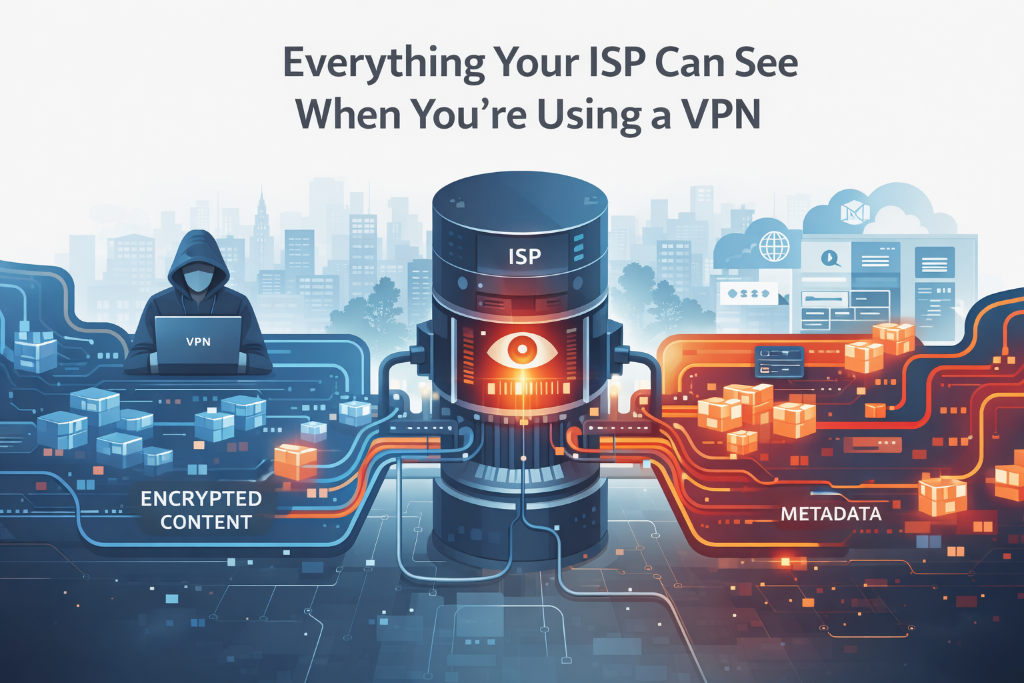
Using a VPN is widely believed to stop internet providers from seeing what you do online, but that belief is only partially true. While a VPN encrypts your traffic, it does not make your connection invisible to your ISP. Metadata, traffic patterns, connection timing, and technical leaks can still reveal more than most users expect. This article breaks down exactly what an ISP can and cannot see when you use a VPN, and where the real privacy limits begin.

Key takeaways
- ISPs can always see that a VPN is being used, along with connection times, data volume, and the VPN IP address.
- Encrypted VPN traffic hides content, but metadata and traffic patterns still allow ISPs to infer user activity.
- DNS leaks, IPv6 leaks, and weak VPN configurations can expose visited domains despite encryption.
- Decentralized VPNs reduce ISP visibility by avoiding shared VPN IPs and centralized logging points.
An Internet Service Provider (ISP) is an organization that provides internet access to individuals and businesses. In essence, they serve as a gateway between your device and your chosen destination.
This gives ISPs a great deal of control. As your traffic passes through their centralized servers, they can monitor, track, throttle, and even block your connection at their discretion. ISPs regularly track the websites you visit, the IP addresses you use, and even your chosen browser. This is both common and completely legal.
Once the ISP has this information, they can use it as they please, whether that be for targeted advertising, bandwidth throttling, or selling your data to third parties. They can also hand it to government agencies upon request. With these concerns in mind, it’s little surprise internet freedom has been a discussion object over the last five years, with 86% of the US population saying data privacy is a growing concern for them, according to KPMG.
To fight back against ISP tracking, many individuals are now opting to use a Virtual Private Network (VPN). These solutions route your traffic through a VPN server and encrypt your browsing data, making it more challenging for the ISP to monitor or track your activities. In theory, if the ISP does intercept your traffic, they won’t be able to view the data and see the websites you’re accessing.
However, as is often the case, it’s not that simple. VPNs may limit ISP tracking, but they can’t eliminate it entirely, and there are several different methods internet providers can use to analyze VPN traffic patterns or exploit vulnerabilities to infer your browsing habits. In this comprehensive guide, we’ll answer the question: can an ISP track a VPN, and if so, what can they see when you’re using one? We’ll also discuss how alternatives, such as the decentralized VPN (dVPN) fix many of the centralized VPN vulnerabilities an ISP can exploit to track your internet activity.
Can an ISP see VPN traffic?
Yes, your ISP can see when you’re using a VPN. While the VPN hides your online activity and the pages you visit, it doesn’t hide the fact you’re connected to the VPN servers.
How can my ISP see VPN use?
Your ISP assigns you a public IP address when you connect to the internet. When you use a VPN, your traffic is routed through the VPN’s servers, and websites see the VPN server’s IP instead of your own. While your real IP is hidden from destination sites, your ISP can often recognize that you’re using a VPN — especially if the VPN provider uses known or publicly listed IP ranges, as is the case with many popular services like NordVPN. This recognition is possible because centralized VPNs, even large ones, typically operate within a finite pool of IP addresses that can be flagged or blacklisted.
Even though your ISP assigns your IP address and doesn’t see anything unusual about it, they can still detect that you’re using a VPN in other ways. For example, VPNs use tunneling protocols such as OpenVPN, WireGuard, or IKEv2, which have distinct characteristics compared to regular HTTPS traffic. These protocols often use specific port numbers and may produce consistent packet sizes depending on how they’re configured. By analyzing factors like port usage, packet patterns, and encryption signatures, ISPs can often infer that a VPN is in use, even if they can’t see the content of your traffic.
What data can ISPs still see when using a VPN?
Can ISPs see through VPNs? And if so, what can they see?
There’s a misconception that the only thing an ISP can see when you use a VPN is the VPN IP address. Let’s expand on the topic and answer the question: what can my ISP see when I use a VPN?
- Your public IP address: This is the IP address assigned to you by your ISP.
- The VPN’s IP address: As mentioned, your ISP can see that you’re using a known VPN IP address. Most VPN providers have a list of predefined IPs, so connecting to one of these IPs is an obvious tell.
- The duration of your connection: The ISP can track when your connection to the VPN service begins and ends. Naturally, this means they can monitor when and for how long you’re connected to the VPN service.
- Total volume of data: Your ISP can also see the total volume of data that you upload and download while using the VPN. While they can’t see the contents of this data transfer, they can use this information to make inferences about your activity.
- VPN protocols: Analyzing packet headers sometimes allows ISPs to determine which VPN protocol you’re using, whether that be OpenVPN, Wireguard, or IKEv2. This is another approach ISPs can employ to detect VPN usage.
- DNS queries: If your VPN doesn’t have its own secure DNS servers, your DNS queries may be routed through your ISP, which will allow them to see the websites you’re visiting. This is known as a DNS leak, and it’s a common VPN security concern.
- Traffic analysis: While the ISP can’t see the contents of the encrypted VPN tunnel, they can use other methods like Deep Packet Inspection to inspect the data and detect that you’re using a VPN. They can also infer your activity based on metadata. If your internet activities have clear patterns, they can even estimate whether you’re streaming, torrenting, or gaming.
- IPv6 leaks: Some VPNs don’t support IPv6 or struggle to route it properly through the encrypted VPN tunnel. If this leakage occurs, your ISP may be able to identify the websites you’re visiting.
- Malicious VPN servers: As all traffic passes through centralized VPN servers, VPN providers can collect logs if they choose. They can provide these logs to the ISP upon request, exposing everything you did while using the VPN connection.
As you can see, many of these issues come down to security concerns with the VPN provider itself. If the service suffers from leaks, or the VPN solution collects user logs, it’s easy for ISPs to learn more information about your browsing activity.
Sadly, there’s no way to be sure that these risks won’t take shape—you have to rely on the word of the centralized VPN provider that they take your privacy and security seriously.
What data is hidden from ISPs when using a VPN?
However, there is some good news. Provided you’re using a reliable VPN, your solution will hide the majority of your data from ISPs, including:
- Browsing history: ISPs typically can’t track the websites you visit, including domain names and web pages, when you use a VPN.
- Communications: Any messages or files you send and receive are usually not visible when you use a secure VPN.
- Downloads: In most cases, ISPs cannot see the content you’re downloading when you use a VPN.
- Typed information: Any queries you enter into search engines are usually safe from ISP tracking when you connect through a VPN.
- Purchases: ISPs shouldn’t be able to track your online purchase history when you use a VPN to connect to the internet.
That said, this element is more nuanced than it at first seems. Let’s expand on some of these points by answering some common questions.
Can my ISP see how much data I’m using with a VPN?
Yes, your ISP can see how much data you’re using, even with a VPN. Your VPN traffic still passes through the ISP’s servers even if the data itself is encrypted. This means they can see how many megabytes or gigabytes you’re downloading or uploading.
In most cases, this isn’t a concern as the ISP can’t see the contents of your traffic. However, if the ISP was determined, they could use your data volume to make inferences about your activity. For instance, consistently high-data usage may indicate streaming, whereas short bursts of intense volume may reveal you’re downloading content.
Can ISPs see what websites you visit?
No, your ISP shouldn’t be able to see the specific websites you’re visiting when you use a VPN. The VPN encrypts your browsing activity—even if the VPN provider attempts to view the page you’re accessing, all they’ll see is a series of encrypted data packets.
However, there is a caveat. If A DNS leak or IPv6 leak occurs, your ISP may still see domain names that you’re trying to access. In countries where VPNs are banned, ISPs may also use more advanced techniques like traffic fingerprinting to estimate your activity based on the size and frequency of data packets.
Can ISPs see what apps you use?
No, ISPs usually can’t see which apps you use when you use a VPN. However, as with seeing the websites you access, a determined ISP could perform traffic analysis to infer your activities based on data packets. Certain apps may be identifiable if they have distinct traffic patterns. However, this is usually only a concern in heavily censored or restricted countries.
Can ISPs see what you download?
No. ISPs can see how much data you’re downloading, but they cannot see the contents of that download. That said, depending on your region, some ISPs may throttle your connection if they discover you are downloading large amounts of content, even if they can’t see the specific files.
Can ISPs see your streaming activity?
Once again, ISPs can’t see your streaming activity directly, but they can infer that you’re streaming content based on the size of your data transfer. Streaming services often have distinctly high usage patterns, meaning determined ISPs can throttle your connection if they choose.
Can my internet provider see what I search with VPN?
No, your ISP can’t see the specific searches you make. The VPN routes all requests through its own encrypted servers, preventing your ISP from seeing them.
Can an ISP block VPN traffic?
Yes, they can. If ISPs choose to, they have several methods to restrict, throttle or block your traffic.
For a start, ISPs can blacklist known VPN IP addresses, preventing you from connecting through the service. As mentioned, most VPN providers use a limited number of IPs, making them easy to detect and block. VPN providers are constantly updating their IPs, but ISPs are never far behind—it’s a never ending game of cat and mouse.
In extreme cases, ISPs can also use deep packet inspection (DPI) to analyze data packets. This is another, more advanced method for detecting VPN usage. They can then throttle or block traffic based on their findings. This is common in regions where VPN usage is banned.
Rather than detecting and blocking VPN use on a case-by-case basis, ISPs can also block the domain name of the VPN provider. This blocks access to the VPN website, preventing ISP customers from accessing and setting up their VPN solution in the first place.
If an ISP truly wants to prevent VPN usage, they will typically employ all of these tactics simultaneously. This is prevalent in regions with strict internet censorship, especially when ISPs work in collusion with governments to prevent VPN usage. VPNs are controlled or outright banned in many highly-restricted countries. This controls the spread of information, allowing governments to push political agendas and prevent dissent.
Currently, 45% of internet users live in a region where VPNs are either banned, controlled or restricted, according to Surfshark. In these areas, VPN blocking isn’t just a frustrating possibility—it’s commonplace, and comes with serious punishments. Let’s examine this problem in more detail.
How do ISPs respond to the use of VPNs?
In most countries with internet freedom, ISPs generally don’t care that you’re using a VPN. They may detect that you’re accessing the web via a VPN provider, but unless they have specific reasons to intercept your traffic, they typically won’t push the issue further.
However, in certain countries around the world, VPN use is illegal or heavily restricted. In these areas, ISPs often work in collaboration with governments to restrict internet freedom and prevent access to content. In North Korea, for example, VPN use is strictly forbidden. Bypassing this law could lead to heavy fines and even imprisonment.
In Russia and China, citizens are only allowed to use government-approved VPNs. These VPNs allow user logs to be collected and provided to the government at any time, meaning individuals using them have little to no true privacy.
Countries like Brazil don’t outlaw VPNs outright, but VPN providers may once again collect user logs and provide them to authorities. Individuals can also be punished for accessing banned websites using a VPN, such as unauthorized gambling or social media sites.
To expand on this topic, let’s break down how ISPs respond to VPN use in different countries around the world.
| Country | Strength of ISP Response | Notes |
|---|---|---|
| China | Very Strong | China uses deep packet inspection, IP blocking, and port filtering to prevent individuals from accessing outlawed VPNs. Apple famously removed all VPN apps from its Chinese App Store following government pressure, preventing access to dissenting viewpoints. Users caught accessing these VPNs face jail time. |
| Iran | Very Strong | Iran outlawed VPN use in 2024, banning all VPNs that aren’t approved by the authorities. These government-approved VPNs allow user logs to be collected and disclosed, significantly limiting individual freedom. |
| North Korea | Very Strong | North Korean citizens are banned from using VPNs. The global internet can only be accessed by high-ranking officials. If ISPs detect VPN usage through DPI, individuals face harsh punishments and imprisonment. |
| Belarus | Very Strong | The Belarusian government actively works with ISPs to monitor internet traffic and detect VPN usage, especially during periods of political unrest. The country’s deep packet inspection (DPI) techniques are advanced, and those caught using a VPN face fines and detentions. |
| Turkmenistan | Very Strong | Extremely strict internet controls. The government controls all ISPs and will go to great lengths to detect VPN use. Those caught face interrogation, imprisonment, and fines. Internet users are forced to swear on the Koran that they won’t attempt to bypass this law. |
| Russia | Strong | Russia implemented its VPN ban in 2017. Only government-approved VPNs are allowed. These VPNs block access to foreign social media sites and collect user logs. Users face fines for noncompliance. |
| Saudi Arabia | Strong | Saudi Arabian ISPs use DPI and IP blocking to restrict VPN usage. This is often to prevent access to foreign applications, like Skype and WhatsApp. Those caught face heavy fines. |
| Turkey | Strong | ISPs in Turkey use DPI to detect and block VPN use, especially during periods of political unrest. In August 2024, the government blocked access to 27 popular VPNs, including NordVPN and Surfshark. |
| United Arab Emirates | Strong | VPNs are restricted for VoIP services. ISPs detect this usage via DPI and IP blacklists. Citizens and tourists caught using a banned VPN can face fines up to 2,000,000 AED (more than 500,000 USD). |
| Pakistan | Strong | Individuals in Pakistan can only access authorized VPNs. The government demands that all VPNs agree to the rules outlined by the Pakistan Telecommunication Authority (PTA) or risk being banned. |
| Egypt | Moderate | VPNs are legal in Egypt. However, the government often works with ISPs to block VPNs during times of political unrest. |
| Brazil | Moderate | VPNs are legal in Brazil, but the government does impose fines for individuals using VPNs to access forbidden sites. For instance, accessing X (formerly Twitter) with a VPN can lead to a 50,000 reais (almost $10000) fine. |
| India | Moderate | VPN use is legal in India, but ISPs do occasionally block VPN use temporarily. VPN providers are also required to maintain user logs for at least 5 years, as of 2022. This led many popular providers to close their India servers. |
| Australia | Mild | VPN use is completely legal in Australia. However, ISPs may throttle VPN traffic to save bandwidth, especially if DPI reveals the individual is downloading large volumes of material. Users can also face fines if they are found to be torrenting content. |
| United Kingdom | Mild | ISPs don’t usually block VPNs in the UK, but they may monitor usage for copyright purposes. In 2012, ISPs blocked access to The Pirate Bay, leading to a surge in VPN use, which authorities began monitoring to detect high-volume traffic. |
| United States | Mild | VPN use is legal but ISPs may throttle traffic at their discretion. For instance, Verizon was accused in 2017 of throttling traffic when streaming Netflix. |
| France | Mild | ISPs don’t block VPN usage outright, but as with the UK, they may monitor usage and throttle connections to prevent VPN torrenting. |
| Japan | None | The Japanese government prioritizes privacy and internet freedom, meaning VPNs are legal to use and not monitored by ISPs. |
| Canada | None | VPNs are legal to use in Canada, with no known cases of ISP restrictions. |
As you can see, the VPN vs ISP battle isn’t straightforward, and the lengths ISPs will go to depends entirely on the country in which you live. ISP tracking is a symptom that takes shape when governments want to restrict internet freedom. And while every country is different, there’s a clear correlation between censorship laws and the invasive methods ISPs use to detect and block VPN usage.
Maximizing VPN effectiveness to prevent ISP tracking
In theory, VPNs are supposed to prevent ISP tracking, but there are a few problems.
- If the ISP can detect you’re using a known VPN IP, they can track, throttle, or block your connection.
- If the VPN isn’t fully secure, DNS leaks can reveal your browsing activity to ISPs.
- If the VPN collects user logs, either by choice or to comply with government legislation, they can provide this information to ISPs and authorities.
As such, it’s up to the internet user to do their due diligence and choose a solution that mitigates these risks. Here are some tips to maximize the effectiveness of your VPN and prevent tracking.
- Choose a reliable VPN provider: Opt for a VPN that’s well-known and reliable. This increases the likelihood that the VPN will keep your data secure and private. Avoid free VPNs, as these providers often sell user data.
- Find a VPN with DNS leak protection: Make sure your chosen VPN provider has DNS leak protection to prevent your ISP from revealing the websites you’re visiting.
- Regularly switch servers: Change your VPN location regularly to prevent your ISP from associating your traffic patterns with that of a VPN server. This is especially important for users in countries where VPNs are banned.
- Choose a VPN with a kill switch: Opt for a VPN that cuts off your internet connection immediately if the VPN connection drops. This prevents unencrypted data from leaking to your ISP.
- Use strong encryption protocols: Choose VPN protocols that have strong encryption standards, like OpenVPN, WireGuard, or IKEv2/IPSec..
- Use split tunneling: Split tunneling lets you choose which apps you access with a VPN and which you access through your normal IP. Use this feature to prevent overusing your VPN for tasks that don’t require it.
These tips will help you get the most out of your VPN service and prevent ISP tracking. That said, choosing the right VPN service can be difficult when all you have is the word of the provider to rely on. For instance, it’s impossible to know whether a provider is collecting logs and selling data. It’s also difficult to know when a VPN’s security has faltered, meaning it’s always a risk when you decide to connect to the internet with a VPN.
As such, some individuals are considering an alternative known as the dVPN, or ‘decentralized VPN’. These solutions offer stronger privacy and security features, making them excellent at preventing ISP tracking. Let’s take a look.
What is a dVPN and how can it prevent ISP tracking?
A decentralized virtual private network (dVPN) is a VPN that runs on a decentralized network of nodes, each hosted by a regular person or business around the world. These nodes are small temporary servers. Whenever you connect to the dVPN solution, you connect to one of these community-driven servers, taking that node’s IP address in the process.
When it comes to preventing ISP tracking, the dVPN has several important benefits:
- No VPN IP addresses: Centralized VPNs typically use a small selection of IP addresses, making it easy for ISPs to see when you’re using one. In contrast, dVPNs have thousands of independent nodes, each of which has its own IP. When you connect to one of these IPs, it looks exactly like you’re connecting to a residential IP from around the world. This makes it far more challenging for ISPs to detect your VPN traffic.
- No centralized servers: When you connect to a conventional, centralized VPN, your traffic passes through the servers of the VPN provider. This is the perfect opportunity for the VPN provider to collect logs if they want to. A dVPN has no centralized servers—your traffic is immediately routed to an independent node. This means it’s impossible for the provider to collect your logs. There’s simply no centralized server where they can do so.
- Fewer users per IP: There are typically multiple people using the same known VPN IP addresses. This makes it easy for ISPs to track high-volume traffic and throttle or block connections. With a dVPN, there are far fewer users per IP, reducing the risk of this happening.
To sum up, dVPN traffic is almost indistinguishable from regular residential traffic, making it as close to an undetectable VPN solution as possible. When using one, it’s more challenging for ISPs to see that you’re using a VPN, meaning they’ll struggle to detect, censor, or block you.
Extra measures to prevent ISP tracking
Aside from using a VPN or dVPN, there are several other steps you can take to prevent ISP tracking online. Here are some of our top tips.
- Use HTTPS: One simple way to boost your resilience against ISP tracking is to stick to websites that have ‘HTTPS’ in their URL. These sites are encrypted, helping to protect data from your ISP. Know that this doesn’t make you completely anonymous. Your ISP will still be able to see the sites you visit, but they won’t be able to see which pages you visit on that website.
- Use privacy-focused browsers: Browsers like Brave and DuckDuckGo are generally considered better for privacy than alternatives. They automatically block trackers and cookies, limiting the data that ISPs can gather on your browsing habits.
- Install browser extensions to block trackers: Similarly, you can also install extensions like uBlock Origin and Ghostery. These extensions prevent third-party trackers and ads that can leak data to ISPs. However, be cautious — some browser extensions can themselves collect and misuse your data, so it’s important to use only well-vetted, reputable tools.
Fighting back against ISP tracking isn’t a set-and-forget solution. If VPN ISP privacy is a priority, you’ll need to consistently evaluate your own security measures and implement as many protocols and solutions as is realistic for your circumstances.