How to Pay for a VPN Completely Anonymously?
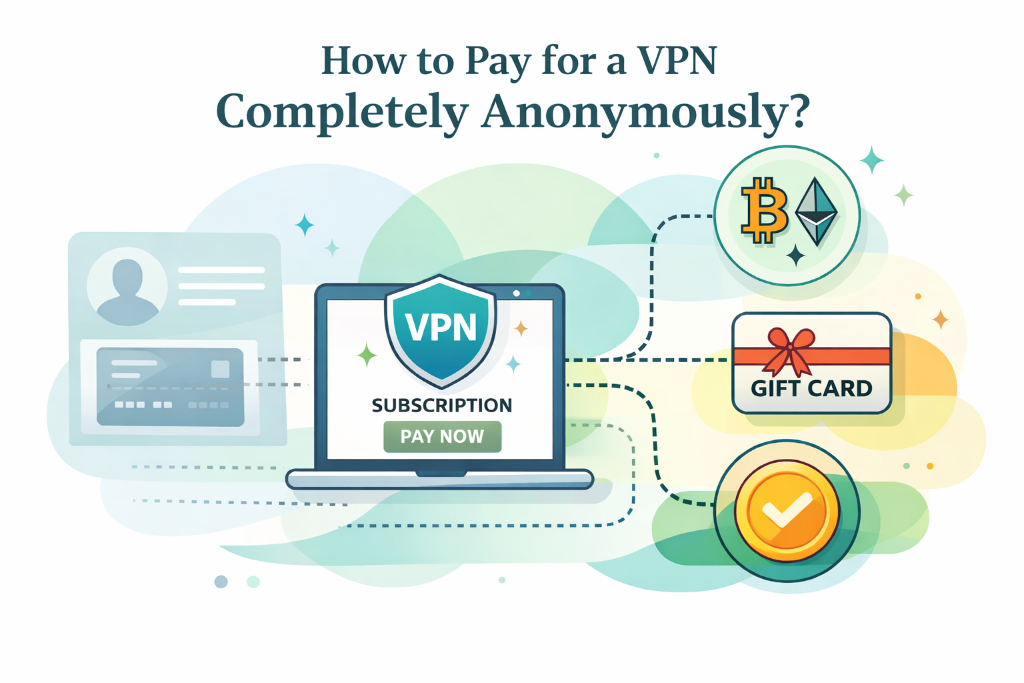
Paying for a VPN is often the first point where privacy quietly breaks down. Even if a VPN encrypts traffic and claims a no logs policy, traditional payment methods can directly link an account to a real identity. Credit cards, PayPal, and app store billing all create records that may be stored, shared, or subpoenaed. This article explains how VPN payments expose users, which anonymous payment options actually reduce risk, and what tradeoffs come with each method.

Key takeaways
- Standard payment methods create identity links that persist regardless of a VPN’s technical privacy claims.
- Cryptocurrency payments reduce exposure only when used correctly and without tying transactions to verified accounts.
- Gift cards and cash based options offer stronger anonymity but limit provider choice and refund protection.
- Anonymous payments improve privacy, but account behavior and device fingerprints can still reveal identity.
A virtual private network (VPN) is a digital security service that creates an encrypted tunnel between your device and the internet. This makes it harder to block or censor you. However, be aware that a VPN doesn’t guarantee complete anonymity.
VPNs can be either centralized or decentralized.
- Centralized VPNs route your traffic through the servers of a single centralized VPN provider, encrypting it in the process before it reaches its destination. In the process, your IP is replaced by the IP of the VPN provider, masking your true identity. This is the most widely used type of VPN among individual consumers.
- Decentralized VPNs (dVPNs) rely on a distributed network of nodes operated by people across the globe. Rather than routing your traffic through centralized servers, dVPNs instead route your traffic directly to one of these nodes. This disguises your IP as that of a regular, residential IP address from around the world.
Both services can enhance your privacy online, but the level of anonymity depends on factors like provider policies, logging practices, and how the VPN is used. But there’s a problem. If you pay for your VPN service via a traditional method, this purchase can be linked to your identity. How can you achieve anonymity if your purchase can be traced?
That’s why we’ve put together this guide to explain how you can pay for a VPN anonymously online. We’ll cover all of the top methods and all the key things you need to consider. Let’s dive in.
Why pay for VPN anonymously?
Here are four reasons you may want to make your VPN payment untraceable.
- Avoiding tracking: If you don’t want your VPN account to be traced back to you, you should always try to pay for your VPN anonymously. Traditional payment methods like PayPal and debit cards can be linked to your VPN account. This can lead to tracking and profiling from authorities and governments.
- Preventing surveillance: Global internet freedom has declined for the 14th consecutive year, with people being physically attacked or killed for their online activities in at least 43 countries in 2024. If you intend to use a VPN to avoid surveillance from governments or authorities, you should pay for your VPN anonymously to prevent your account from being linked to your identity.
- Reducing the risk of data breaches: If a cybercriminal attacks and breaches a centralized VPN provider, they can gain access to personally identifiable information (PII), such as payment data. This can be used to steal your identity, commit fraud, or track your online activity. By paying anonymously, you minimize the amount of PII stored by the VPN provider, reducing your exposure in the case of a data breach.
- To publish content: If you want to publish material online anonymously, either because you’re a journalist or live in a country where internet freedom is heavily restricted, paying for a VPN anonymously will make it much more difficult for third parties to reveal your identity.
In essence, if you want to avoid your VPN account from being traced back to you for any reason, you should pay anonymously.
Are there any risks of paying for a VPN anonymously?
Despite the many benefits of paying for a VPN anonymously, there are some risks you should be aware of:
- Limited opportunities for refunds: Anonymous payments can make refunds or chargebacks more complicated, as VPN providers may not have a way to verify the transaction details. If you find yourself disappointed with the VPN solution, you may find it difficult to get your money back.
- No recurring payments: Similarly, paying for a VPN anonymously means you won’t be able to set up recurring payments. Since recurring payments are not an option with anonymous payment methods, you’ll need to remember to renew manually to avoid service interruptions.
- Difficulty resolving errors: If an issue occurs during the payment process, or you’re having technical difficulties with the VPN itself, it can be challenging to resolve these errors without identifiable payment details.
- Complexity: In some cases, making payments anonymously can be tedious and difficult, with technical experience required. It isn’t as simple as opening an incognito window. Fortunately, there are less complex options.
- Association with illegality: Anonymous payments can sometimes be associated with illegal activities by authorities. If you live in a jurisdiction with strict surveillance and regulations, these payments could still be traced back to you if the payment method can be linked to your identity.
Top methods to pay for a VPN anonymously
There are five primary ways to pay for a VPN anonymously. Let’s dive into each one by one. We’ll also provide pros and cons, as well as advice to decide a method is right for you.
1. Cryptocurrency
Cryptocurrency is the most popular method used to pay for a VPN anonymously. Here’s everything you need to know.
Overview
Cryptocurrency is a decentralized digital currency that operates on blockchain technology. It allows users to make transactions without going through traditional financial institutions, offering varying degrees of privacy depending on the currency you use. Common examples include Bitcoin, Ethereum, and more privacy-focused coins like Zcash and Monero.
Cryptocurrencies are popular for anonymous payments because they are decentralized. Rather than passing through a centralized banking system, each cryptocurrency operates on its own blockchain—a public ledger that records transactions. This means your payments are not directly tied to your personal identity, offering privacy when used correctly.
How anonymous is this method?
You should know that cryptocurrencies aren’t always completely anonymous. In fact, they are ‘pseudonymous’ by design. Transactions are tied to your unique cryptocurrency wallet address rather than your real identity, and your transactions will still be recorded on a public ledger—meaning you aren’t necessarily untraceable.
That said, certain privacy-focused cryptocurrencies like Monero and Zcash help with anonymity by using advanced cryptographic methods to obscure your transaction details. These currencies are your best bet if you want to remain truly anonymous when making a payment to your chosen VPN or dVPN provider, though they are less widely accepted and more difficult to access.
There’s also the option of using a Bitcoin ATM to maximise your anonymity. These ATMs aren’t available everywhere, but if they’re in your area, you can visit one in person to deposit the funds manually. Just be aware that Bitcoin ATMs require a phone number for a verification code. If you want to remain truly anonymous, use a temporary phone with a prepaid SIM. You can find Bitcoin ATMs in your area via a Coin ATM Radar.
Cryptocurrency benefits
- No personal information required: Payments can be made without revealing your name, address, or financial details.
- Decentralized: Transactions don’t rely on centralized institutions, reducing your exposure to surveillance.
- Accessibility: Cryptocurrency is accessible for users worldwide without restrictions.
- Acceptance: Cryptocurrency is the most widely accepted anonymous payment method for VPNs and dVPNs.
Cryptocurrency drawbacks
- Not fully anonymous by default: Most mainstream cryptocurrencies like Bitcoin are pseudonymous, meaning transactions can still be traced in certain situations.
- Technical experience: Ensuring total anonymity when using cryptocurrencies often requires additional steps, which can be technically challenging.
- Pricing volatility: Cryptocurrency prices can fluctuate at any time, potentially impacting the cost of the VPN service.
Who is this solution best for?
- Users who want anonymity and are familiar with cryptocurrency technology.
- Individuals using decentralized VPNs.
VPNs that accept this method
Cryptocurrency is widely accepted by many centralized VPN providers such as:
- NordVPN
- Surfshark
- ExpressVPN
- CyberGhost
- PrivateVPN
It’s also accepted by several decentralized VPN providers, like PortalsVPN and Sentinel.
How to pay for a VPN anonymously with cryptocurrency
If you’d like to buy a VPN with crypto anonymously, here’s how to do so:
- Establish a wallet with your chosen cryptocurrency that is compatible with CoinGate, CoinPayments, or BitPay.
- Choose a VPN or dVPN that allows you to pay via your chosen cryptocurrency.
- Purchase a slightly higher amount of cryptocurrency you need for the transaction and transfer it to your wallet.
- At the checkout, choose cryptocurrency as your preferred payment method.
- Follow the steps to transfer the crypto from your digital wallet to the provided address.
Tips to remain anonymous with this method
Here are some best practices to maximize your anonymity when using cryptocurrency to pay for your VPN service.
- Acquire the crypto anonymously: Avoid exchanges that require KYC (Know Your Customer) verification. Instead, buy your crypto via decentralized exchanges (DEX), peer-to-peer crypto exchanges or Bitcoin ATMs. Bitcoin ATMs, in particular, are safe, and a solid bet for anonymity. However, they have high fees and might require identity verification or a phone number above a certain amount, which may reduce privacy.
- Load the funds anonymously: You should also avoid sending the funds to your crypto exchange wallet from your bank account, as this can be linked back to you. Instead, use a prepaid debit card to make the transaction chain harder to track.
- Mixing services: Leverage mixing services like Whirlpool or Whir. These tools mix potentially identifiable cryptocurrency funds with others, making it nearly impossible to trace the funds back to its original source.
- Use privacy-focused coins: Privacy cryptocurrencies like Monero make your transactions private on the blockchain by default, obscuring the sender, recipient, and transaction amounts. However, if you acquire Monero through a centralized exchange that uses KYC, your initial purchase is still linked to your real identity. To enhance anonymity after withdrawal, you can ‘churn’ the Monero by sending it to yourself in one or more internal wallet transactions, making it more difficult to associate the funds with the exchange withdrawal.
Cryptocurrency isn’t necessarily the easiest way to pay for VPN anonymously, but when done right, it’s one of the safest ways to maintain your privacy when you make a purchase.
2. Prepaid debit cards
Another viable option for anonymous VPN payments is prepaid debits. Here’s how they work.
Overview
Prepaid debit cards are debit cards that you load with money in advance. These cards can then be used for online or in-store purchases. Popular options include Maestro, Boleto, Mint, FanaPay, and Dankort.
Prepaid debit cards work exactly like a regular debit card and, crucially, they generally can be bought with cash in retail stores without ID verification. This means, if you pay cash and don’t buy it online, the prepaid debit card won’t be linked to your bank account or identity.
If you choose this method, you should be aware that there are two different types of prepaid debit cards available.
- Open-loop cards can be used anywhere that accepts the debit/credit card payment method. These can be used for purchasing a VPN anonymously.
- Closed-loop cards can only be used at specific stores. These cannot be used to make VPN payments.
Make sure you’re buying an open-loop card before you commit to a purchase.
How anonymous is this method?
Provided you’re paying with cash, prepaid debit cards offer a lot of anonymity since they don’t require any personal information to be linked to the card itself.
That said, if you buy the card online or register it under your name in a store, this will seriously undermine your efforts to remain anonymous. In addition, many popular VPN providers require you to register the prepaid debit card online with an address and name, so you’ll need to choose a provider that allows prepaid cards bought in-store.
Prepaid debit card benefits
- No personal information required: Prepaid cards often don’t require any personal information when you pay with cash.
- Widely accepted: Many VPN providers accept prepaid debit cards, though some may require that the card is registered online.
- Convenient: Prepaid debits are easy to obtain and require no technical expertise to set up.
- No credit check: Prepaid debit cards aren’t tied to your credit line because you pay upfront. This means there’s no chance of being excluded due to a low credit score.
Prepaid debit card drawbacks
- No option for recurring payments: Prepaid debit cards only allow for one-time transactions. Many popular VPNs require a subscription service, so you’ll need to manually send money each month.
- Additional fees: Some prepaid debit cards have activation fees and transaction fees, which can add up over time.
- VPN requirements: Some popular VPNs require your debit card to be activated online before it will be accepted. This limits use cases when trying to buy a VPN anonymously.
- Retailer requirements: Some retailers may ask for personal information, such as your phone number and email address, before they provide you with the card.
- Card activation: Some prepaid debit cards—even those bought with cash—-may need to be activated online before they can be used to buy things digitally.
Who is this solution best for?
- Users who need a simple way to pay for a VPN anonymously.
- Those who lack technical expertise to use a solution like cryptocurrency.
- Users who don’t mind shopping around to find the best prepaid debit card and a VPN provider that doesn’t ask for personal information before using the card.
VPNs that accept this method
Prepaid debit cards are accepted by most popular centralized VPNs and dVPNs, including:
- PortalsVPN
- NordVPN
- Surfshark
- Express VPN
- CyberGhost
- Atlas VPN
- Proton VPN
Note that some of these VPN providers may require you to activate your card online. It’s always worth reading the terms and conditions when choosing your provider.
How to pay for VPN anonymously with a prepaid debit card
Think this method is the best option for you? Here are the steps to take.
- Purchase your prepaid debit card in a retail store with cash.
- Choose a plan with your chosen VPN and go to the checkout page.
- Select ‘debit card’ as your chosen payment method.
- Enter in the details on the prepaid debit card and complete the transaction.
Tips to remain anonymous with this method
Here are some quick reminders about how to remain anonymous with a prepaid card.
- Avoid registering the card: Don’t buy a prepaid card with cash if you need to activate it online before use. This creates a digital footprint that leads back to you.
- Reload with cash: If you need to reload the card, always do so in-person and pay in cash.
- Check for policy: Always read the payment terms for VPN providers to check whether they need you to activate your prepaid debit online before you pay.
There are a lot of problems with prepaid gift cards, namely that retail stores and VPN providers are increasingly requiring digital activation. That said, if you do find a card and provider that allows cash-paid cards, this is one of the simplest and most effective ways to pay for your VPN anonymously.
3. Gift cards
Another option for paying anonymously is to use a gift card.
Overview
In some respects, gift cards are similar to prepaid debit cards. You can buy them in-store with cash and provide the card as payment for your VPN. In most cases, you can do this without revealing any personal information. Provided you pay with cash and the gift card doesn’t require personal information or online activation, this is a safe, quick way to remain anonymous.
However, gift cards are typically closed-loop, meaning they can only be used to purchase products with the retailer you bought it from. An Amazon gift card can only be spent on Amazon products, for example.
Some VPN providers may accept gift card codes as a form of payment. They will then spend these gift cards themselves. However, most established VPN and dVPN providers don’t accept this as a payment method, so your options are extremely limited compared to alternatives. For this reason, many people prefer to opt for a prepaid debit instead if they lack the expertise to use cryptocurrencies.
How anonymous is this method?
As long as you pay with cash and don’t need to activate your card online before use, gift cards are a very secure, anonymous way to pay. This is because you aren’t actually making a direct payment. Instead, you’re sending the gift card code for the VPN provider to use themselves. The gift card itself is the payment method.
As ever, how anonymous you’ll be will depend on other factors. If you buy the gift card online or need to provide personal information to make the purchase in cash, this will allow the gift cards to be linked back to your identity.
Gift cards benefits
- No personal information required: As long as you buy in cash, many gift cards don’t require personal information.
- Easy access: Gift cards are widely available at millions of retail stores worldwide.
Gift cards drawbacks
- Not widely accepted: Most VPN and dVPN providers don’t accept gift cards as a valid form of payment. Some providers may also only accept gift cards from specific brands, like Amazon.
- Fixed price points: Gift cards come in fixed denominations ($10, $20, $50, etc). If your VPN subscription cost doesn’t line up exactly with the money on your gift card, you won’t receive any change for your purchase.
- One-time purchase: Because you’re paying for the VPN subscription with your gift card itself rather than the balance of that card, using a gift card is a one-time purchase, making it inconvenient for subscriptions.
Who is this solution best for
- People who want a simple method who don’t have technical expertise.
- Those who have a specific VPN in mind that accepts gift cards.
VPNs that accept this method
Very few VPN providers accept gift cards as a valid payment method. One notable exception is NordVPN, who offer a retail box that you can buy in-store with a relevant gift card. Aside from that, there are very few options.
Some providers like PureVPN do allow you to pay via gift card, but this is typically through a third-party payment processor like Paymentwall. This service is only available in certain regions and may require additional verification, undermining your anonymity.
How to pay for a VPN with a gift card
Here’s how to pay for your VPN with a gift card:
- Find a VPN provider that accepts gift cards as payment.
- Check the subscription costs for that provider.
- Go to a local retailer and buy the gift card. Try to make sure the gift card balance closely matches the subscription cost for your VPN.
- Choose a plan with your chosen VPN and go to the checkout page.
- Select ‘gift card’ as your chosen payment method.
- Enter in the gift card details and pay.
Tips to remain anonymous with this method
Here are three tips to remain anonymous when using gift cards.
- Don’t register with personal details: When you buy in-person with cash, don’t register any details that could be traced back to you.
- Don’t buy a card online: Never buy your gift card online, as this will then be registered to your name.
- Read supplier terms: Check whether a payment provider truly allows gift cards sent directly before you commit to a purchase.
4. Virtual credit cards
Virtual credit cards have been growing in popularity as an alternative to traditional debit or credit cards, offering enhanced privacy. Here’s what to know.
Overview
Virtual credit cards are temporary or permanent digital card numbers that are linked to your real bank account but not to your identity. The card uses a masked, unique card number that’s different from your usual card number. This protects your real card details and your account information in the process, preventing sellers from seeing your details.
How anonymous is this method?
By default, virtual credit cards are not a total solution for anonymity. When you make a payment with a virtual credit card, the seller won’t be able to see your details. However, because these cards are still linked to your real bank account, they can be traced through the payment card company.
To increase anonymity, there is the option of loading funds using prepaid debit cards rather than your bank account, though you’ll need to check the terms and conditions of the virtual credit card to know whether this is possible. Some cards will also require you input your name as the account holder when you sign up.
Virtual credit card benefits
- Widely accepted: Most VPNs and dVPNs accept virtual credit cards as a valid form of payment.
- Partial anonymity: Sellers won’t be able to see any of your payment information when you make a purchase.
- Fraud prevention: You cannot be charged to a virtual credit card without your approval, meaning they’re an excellent way to protect against fraud.
Virtual credit card drawbacks
- Not fully anonymous: In many cases, you’ll need to tie your virtual card to your bank account, meaning your payment provider can still link the transaction to your identity.
- No recurring payments: As virtual credit cards cannot be charged without your approval, so they can’t be used for recurring subscriptions.
- Limited availability: Virtual credit cards are a relatively new technology, so some banks don’t offer them.
- Difficult to achieve true privacy: While loading virtual credit cards with prepaid debit cards could provide total anonymity, finding a virtual credit card that accepts this funding method can be challenging.
Who is this solution best for
- Users who want enhanced privacy for online transactions without needing complete anonymity.
VPNs that accept this method
Virtual credit cards are accepted by most popular VPNs and dVPNs, including:
- NordVPN
- Surfshark
- ExpressVPN
- TorGuard
- PureVPN
- PortalsVPN
How to buy a VPN anonymously with a virtual credit card
If you decide this method is right for you, here are the steps to take.
- Find a VPN or dVPN provider that accepts virtual credit cards.
- Check whether your current payment provider has a virtual credit card available.
- If so, sign up for a virtual credit card. If not, find a payment provider that offers this service.
- Use your virtual credit card to pay for the VPN at checkout.
Tips to remain anonymous with this method
Total anonymity is difficult when you use a virtual credit card. The one tip we can provide is to fund anonymously where possible. Prepaid debit cards are the most common method, though some may accept cryptocurrency. Avoid linking the virtual credit card to your personal bank account.
5. Cash
The final option we’ll cover is cash payments. Let’s dive in.
Overview
Paying in cash is a secure and anonymous method for buying a VPN or dVPN. There are three options available to you.
- Sending cash directly to the VPN provider, though note that this is rarely accepted.
- Buying a physical retail box in a store. Only NordVPN offers this option.
- Using your cash to fund a prepaid debit card or gift card. The most accessible option.
The problem with cash payments is that very few providers will accept them. This makes the method largely impractical unless you intend to use cash to fund a prepaid debit card.
How anonymous is this method?
Cash is the most anonymous method of all because it leaves no digital paper trail that can be tied back to you. Note that sending cash through the mail could still leave indirect physical tracking options. Of all of the three options, sending cash directly to the VPN provider is the most anonymous, as it’s easy to ensure privacy. Unfortunately, however, it’s difficult to find a VPN that offers this service.
Buying a physical retail box in-person is a valid solution for anonymity, but only if you want to use NordVPN—this is the only provider that offers this solution. Physical retail boxes are also only available in select countries, such as the US, Germany, and Japan.
Lastly, you can use cash to pay for a prepaid debit card or gift card, both of which we’ve covered above. This method is anonymous as long as you don’t give any personal details when you sign up.
Cash Benefits
- Complete anonymity: No personal information tied to the payment.
- No digital trail: No record of the transaction occurring.
Cash drawbacks
- Limited options: You don’t have many options when deciding which VPN to choose from.
- Risk of loss: Sending cash in the mail always comes with a risk of losing the money.
- Inconvenience: Using cash payments can be inconvenient and slow compared with digital methods.
- No recurring payments: As you’ve paid cash, you’ll need to send money again when you want to renew your subscription.
Who is this best for?
- Those who need complete anonymity and don’t mind a bit of inconvenience.
- Those who want to avoid digital payment systems entirely.
VPNs that accept this method
Very few VPN providers accept cash directly. Some exceptions include:
- Mullvad VPN
- Proton VPN
There’s also the option of buying the NordVPN retail package, or converting your cash to a prepaid debit card, which is much more widely accepted.
How to pay for a VPN with cash
Here’s how to pay for a VPN with cash.
- Find a VPN provider that accepts cash payments.
- Obtain the cash required to make the payment.
- Send the money directly to the VPN provider’s address. Include your username or other identifier so the VPN can attribute the payment to your account.
Tips to remain anonymous with this method
Lastly, here are some tips to keep yourself anonymous:
Use a PO box: If you’re mailing cash, avoid using your real name and return address. Use a PO box or a trusted intermediary address if necessary. Even better - avoid using a return address at all. Create your account anonymously: You’ll usually need to include an account name/number when you mail cash, so make sure you follow all steps to ensure this account is created anonymously.
Additional tips for paying anonymously
Here are five additional tips to pay for a VPN anonymously.
- Use a one-time email address: When signing up for the VPN or dVPN service, use a one-time or anonymous email address to prevent the account from being linked to your regular email.
- Use a VPN or Tor during the setup process: If you want to remain as anonymous as possible during this process, make sure you use a VPN or Tor while setting up your VPN account.
- Use incognito mode: Use incognito mode to prevent your browser from storing cookies that reveal information about your transaction once you exit the browser.
- Use privacy-focused browsers: Ideally, use a privacy-focused browser like Brave, as this will block most trackers automatically. They also offer built-in Tor integration for added anonymity.
- Avoid personal devices: Avoid using your own personal devices to complete the purchase, as these devices contain personal information that can be used to trace your identity. Opt for a disposable or secondary device where possible.
Which VPNs accept anonymous payment methods?
Below is a table showing all of the payment methods we’ve discussed and which VPN providers accept them.
| VPN | Crypto | Prepaid debit | Gift card | Virtual credit card | Cash |
|---|---|---|---|---|---|
| PortalsVPN | ✓ | ✓ | ✓ | ||
| NordVPN | ✓ | ✓ | ✓ | ✓ | ✓ |
| Surfshark | ✓ | ✓ | |||
| ExpressVPN | ✓ | ✓ | ✓ | ||
| CyberGhost | ✓ | ✓ | ✓ | ||
| ProtonVPN | ✓ | ✓ | ✓ | ✓ | |
| Private Internet Access | ✓ | ✓ | ✓ | ✓ | |
| IPVanish | ✓ | ||||
| Mullvad VPN | ✓ | ✓ | ✓ | ||
| Hotspot Shield | ✓ | ||||
| Windscribe | ✓ | ✓ | ✓ | ✓ | |
| VPN Unlimited | ✓ | ✓ | |||
| PureVPN | ✓ | ✓ | ✓ | ||
| VyprVPN | ✓ | ✓ | |||
| Ivacy VPN | ✓ | ✓ | ✓ |
Let’s unpack this data by exploring our top picks for the best VPN options based on privacy, security, and the number of payment methods available.
1. PortalsVPN - The best for total anonymity
PortalsVPN is a decentralized VPN solution, meaning it runs on a peer-to-peer network of independent computers run by regular people. When you connect to the service, your traffic is encrypted and routed directly to one of these independent computers. This supports your anonymity in two key ways:
- Your IP will be indistinguishable from a regular residential IP, making it much harder for destination services and websites to detect that you’re using a known VPN IP and block your connection.
- As PortalsVPN runs on a decentralized architecture, this makes collecting logs by VPN provider much harder, if not near-impossible. Your traffic never passes through the centralized servers of a VPN provider, meaning there’s no opportunity for the provider to collect your data.
PortalsVPN accepts several anonymous payment methods, including cryptocurrency and prepaid debits. While it doesn’t have as many options as NordVPN, it makes up for this by offering superior privacy.
2. NordVPN - The most payment options
NordVPN comes in second because of its security, accessibility, and the number of payment methods on offer. It currently accepts all forms of anonymous payments, including cash, if you buy a subscription in store.
NordVPN can help you keep your connection private in most cases. That said, it doesn’t offer the same level of anonymity that a decentralized solution like PortalsVPN provides because it’s built on a centralized architecture, which is more vulnerable to monitoring and user logging. The VPN also suffered a data breach back in 2018, where attackers were able to gain unauthorized access to one of the VPN’s servers in a third-party data center through an insecure remote management system.
If you’re looking for an easy to use, centralized VPN with a wide range of payment options, NordVPN is a solid choice, even if it does lack some of the anonymity that a decentralized solution offers. For instance there’s also no way to guarantee that NordVPN isn’t collecting your log data, as it’s a possibility from a technical standpoint.
3. ProtonVPN - The best free option
If you’re absolutely set on a free VPN, ProtonVPN is a valid choice. It only lets you protect one device, but it won’t show you any ads, which can be hard to come by when choosing a free VPN. Also it prevents you from streaming content and torrenting on free version, limiting your use cases.
That said, in most cases, it’s inadvisable to choose a free VPN. Providers need to make money somewhere, so if they’re offering a VPN for free, this might mean they’re making money in other areas, such as by collecting and selling your data to third parties.
Proton does claim to have a no logs policy, but it’s impossible to prove that this is true. For privacy and anonymity, it’s better to opt for a paid solution, but if a free VPN is your only option, Proton is a good choice.
How to maintain your anonymity after paying for a VPN anonymously?
Paying for a VPN anonymously is just the first step. To ensure your online activities remain untraceable, you must also take steps to maintain anonymity during and after using the VPN. Here are some tips.
- Opt for a decentralized VPN: With dVPNs, your traffic never passes through a single centralized server, meaning it’s much harder for third parties like internet service providers to detect or block your traffic. Your IP looks exactly the same as a residential IP from around the world rather than being recognizable as that of the VPN provider.
- **Choose a VPN with a kill switch: Find a VPN that has a kill switch if the VPN connection drops. This will prevent unencrypted data from leaking.
- Install browser extensions to block trackers: Extensions like uBlock Origin and Ghostery stop third parties from tracking you, preventing opportunities for trackers to leak your data to ISPs. However, note that third party extensions introduce their own risks, and they don’t prevent your ISP from seeing your traffic unless you’re using a VPN or Tor.
- Be cautious of browser extensions: Only install browser extensions that you trust. Some may collect and share your data. Regularly review and remove unnecessary add ons.
Alternatives to paying for a VPN anonymously
While there are many great, low-risk ways to pay for a VPN anonymously, it isn’t for everyone. Here are some alternatives if you need to take steps toward digital anonymity but don’t want to get a VPN using one of the anonymous methods outlined in this guide.
- Use a free VPN: Free VPNs don’t require any payment, and you can sign up for one using a burner email account. That said, keep in mind that free VPNs often have poor privacy policies and features. They’re also well-known to log user data, which could undermine your anonymity.
- Tor Network: Tor is a free solution that provides excellent anonymity. It routes your internet traffic through multiple volunteer-operated nodes (known as multi-hop routing), hiding your IP address in the process. That said, Tor will slow down your internet speed, meaning it might be cumbersome to use and is less suitable for large downloads.
- Open source VPNs: Open-source VPNs like OpenVPN and WireGuard allow you to set up and manage your own VPN server. This gives you full control over your own privacy. However, they do require quite a lot of technical knowledge and effort to establish and maintain.
- Donation-based VPNs: Some VPNs, such as RiseupVPN and Fine VPN, operate on a donation-based model, allowing users to support the service without making mandatory payments each month. Know that these services might have limited resources or slower speeds compared with commercial VPNs.
Frequently asked questions
Is it legal to buy a VPN anonymously?
In most countries, it is legal to buy a VPN anonymously. Illegality only begins when you use your VPN to do something illegal. In some countries, such as China, Russia, and North Korea, VPNs are illegal or heavily restricted, so paying for one anonymously can raise legal concerns.
Is it safe to pay for a VPN with Bitcoin?
Yes, paying for a VPN with bitcoin is safe, but if you want to remain anonymous, you should take extra steps to ensure your privacy. Use privacy-focused currencies, mixing services, or Bitcoin ATMs with a single-use phone to maintain your anonymity.
Is it safe to buy a VPN subscription with a credit card?
Buying a VPN with a credit card is safe from a technical standpoint, but it won’t help you remain anonymous if it’s tied to your bank account. A prepaid debit card or virtual credit card are better options for total privacy.
Can I use free VPNs more anonymously than paid ones?
Not necessarily. While you won’t need to send any payment details to use a free VPN, there are several other problems that make paid VPNs more secure. For one, many free VPNs log user data, and some even sell this data to third parties to generate revenue. Free VPNs may also be less secure and with fewer locations, impacting your user experience.
Will I be able to get a money-back guarantee if I pay for a VPN anonymously?
If you want to be truly anonymous (providing no information that can be used to trace your identity) it can be hard to secure a refund when paying for a VPN anonymously. Cryptocurrencies are the exception here, as VPN providers may be able to refund the payment. Technically, a VPN provider could also return cash, though this is rare. For gift cards, virtual credit cards, and prepaid debits, a refund is rarely possible.
Are anonymous payments more commonly allowed by decentralized VPNs than by centralized ones?
Yes, decentralized VPNs (dVPNs) are more likely to support anonymous payments compared to centralized VPNs. dVPNs like PortalsVPN prioritize user privacy and accept cryptocurrencies along with other anonymous methods.