Unrestricted Internet Access: Everything You Need To Know
Most people assume the internet is open by default. In reality, what you can access, share, or even search for is quietly shaped by governments, ISPs, and platforms. True unrestricted internet access challenges this status quo, promising digital freedom while introducing new legal and security risks. Is a fully open web possible, and if it is, who really benefits? This guide explores the limits of online freedom and how far they extend.

Key takeaways
- Most internet users only see a filtered version of the web shaped by laws, platforms, and infrastructure rather than technical limitations.
- Unrestricted internet access is as much a political and economic challenge as it is a technological one.
- Tools like VPNs, dVPNs, Tor, and proxies enable access, but each introduces tradeoffs in legality, privacy, and security.
- A fully open internet expands freedom, but it also shifts responsibility and risk directly onto the user.
Envision a society where all individuals have access to the entire spectrum of information available on the internet, regardless of their geographic location, socio-economic status, and political environment. In this society, users from across the globe can engage in open discussions free from censorship. Students from remote villages can access learning materials from prestigious educational bodies. Entrepreneurs in developing nations can advertise their products in global markets. Everyone has equal and uninterrupted access to every site, solution, and service at all times.
This is the concept of the unrestricted internet. But it’s just that—a concept. Current estimates reveal that only 18% of the global online population has total internet freedom, according to a study published by Ani Petrosyan on Statista. Even more worryingly, the same study reveals that three in four individuals live in countries where people are arrested or imprisoned for discussing political, social, or religious issues online. This happens even in progressive countries such as the UK and Canada.
Unrestricted web access is considered a modern human right, but we still have a long way to go to achieve it. The promising news is that internet freedom is possible. Global cooperation among governments and industry leaders, as well as international advocacy for net neutrality could lead to worldwide unrestricted internet access in the future. But this won’t be an easy battle.
In the meantime, proxy servers, VPNs, and dVPNs offer a route to the unrestricted internet by allowing users to bypass geographical restrictions. This, in theory, gives users access to content that wouldn’t usually be available to them. But should we require these tools to achieve internet freedom?
The primary ambition of the unrestricted internet is to give the end user the power to decide how they use the web, but reaching this goal won’t be easy. And, if we do reach it, is it actually for the best? Or could we be introducing new risks? We’ll explore this debate in detail in this guide while providing advice on how to access the unrestricted internet. But first, let’s define the ‘unrestricted web’ in greater detail.
What is unrestricted internet?
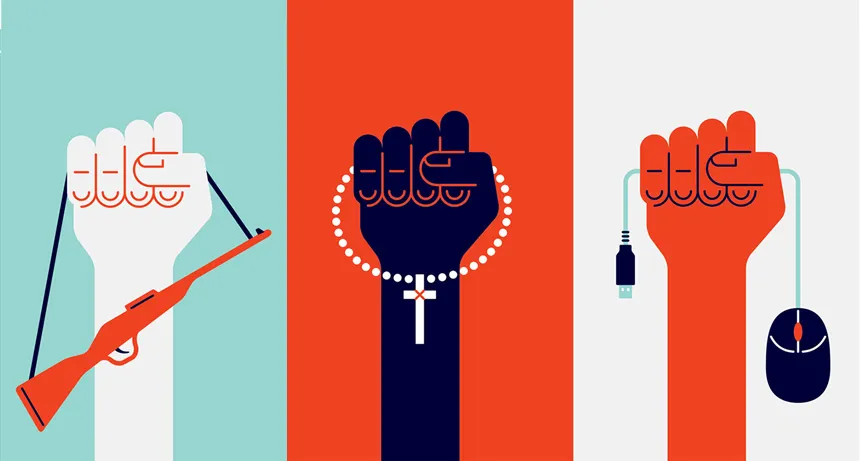
The unrestricted internet is an internet free from limitations imposed by external entities. It enables every individual to navigate every feature and service on the web without restriction, throttling, or censorship.
Whenever you search on Google, the content that is presented to you is determined by the search engine based on your location, local laws, and individual user profile. This means you only see a small percentage of the pages on the web. Unrestricted internet access removes these barriers, meaning you can access every type of content, including streaming services, social media sites, and online resources, regardless of who you are or where you live.
In a broader sense, unrestricted internet access is concerned with net neutrality—the idea that ISPs should treat every user equally without throttling (slowing down), impeding, or blocking access to content on the web. Similarly, unrestricted internet access encompasses freedom from censorship, where individuals can speak their mind online without fear of repercussions.
Ultimately, the core goal of the unrestricted internet is to provide equality and freedom to everyone, but is achieving this ambition feasible? And if so, do we truly want it?
Is unrestricted internet access possible?
Yes. Unrestricted internet access is possible, but total internet freedom isn’t going to arrive on a global scale any time soon.
The biggest hurdles stem from politics and geography. While progressive countries like Estonia and Iceland are considered to have a high degree of internet Freedom, according to Freedom House, other countries like China, Cuba, Azerbaijan, Bahrain, and Russia still heavily censor and control their populations’ online activity to push political agendas and enforce cultural norms.
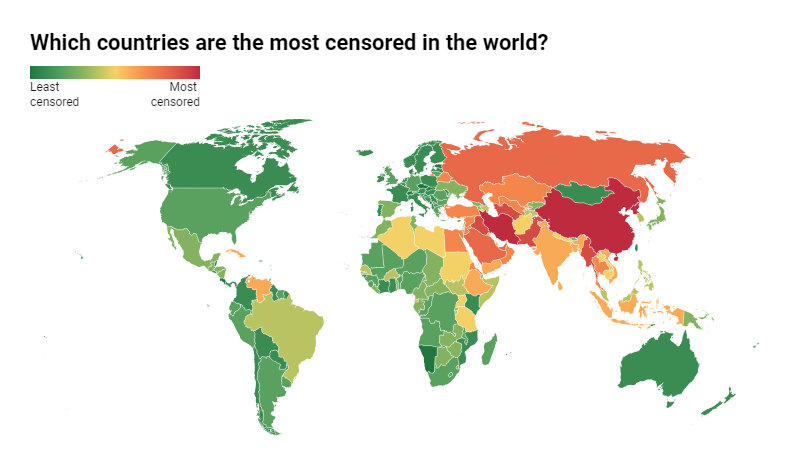
Changing this landscape requires global activism to push for digital equality. This would demand coordinated efforts from governments, organizations, industry leaders and society. While this is possible somewhere down the line, it will take a long time to come to fruition.
In the meanwhile, VPNs and proxy servers are currently the most effective ways to access the unrestricted internet. These services mask your IP, making it more difficult to track, block, or censor you. However, this isn’t foolproof, and these services are either illegal or heavily regulated in some countries that oppose unrestricted internet access.
In North Korea, Oman, Turkmenistan, and Belarus, for instance, using a VPN could land you heavy fines or even imprisonment. Larger nations like China and Russia allow VPN usage, but only through government-approved VPNs that collect user logs. As you may have guessed, these logs can then be provided to the government upon request.
Concerningly, global internet freedom has declined for the 13th consecutive year, according to the Freedom on the Net report of 2023. But why is this the case? Let’s take a closer look.
Why is internet access restricted?
There is no singular reason why the internet is restricted. The problem stems from a combination of government influence, the motives of private companies, logistics and economics. There are four main reasons for this, as outlined in this infographic.
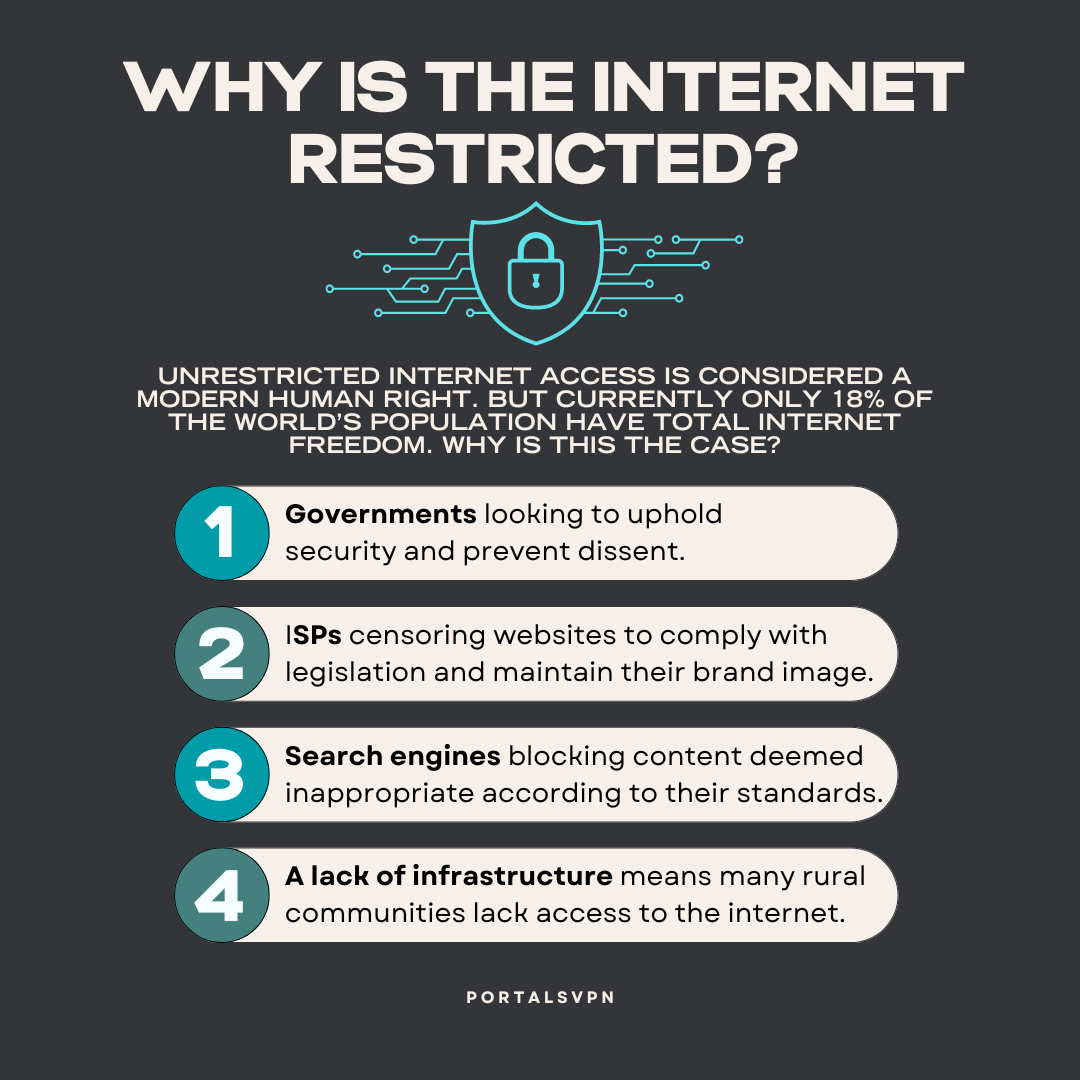
Let’s explore these factors in greater detail to provide you with the complete picture.
Government involvement
Some government bodies want to restrict what can be accessed, viewed, or published on the internet within their jurisdiction. There are several reasons for this. Some do it to protect users from inappropriate content and uphold national security. Others may restrict content to impose traditional values and control the spread of information.
This kind of censorship is more prevalent than you might think, even in Europe. In Lithuania, for instance, the government blocks popular torrent websites to prevent the download of pirated content. In Hungary, a telecommunications company with strong ties to the government recently consolidated its market position by acquiring Vodafone’s Hungarian arm. In the UK, the Online Safety Bill passed in September 2023, giving the relevant Secretary of State the power to suppress speech and media labeled “harmful”.
In severe cases, governments may also block access to social media to prevent dissent and maintain political stability, as is the case in countries like China, Russia, Iran, and Myanmar. This is one of the most oppressive forms of internet restriction, and it’s surprisingly common. According to Freedom House’s 2022 Freedom on the Net report, users faced legal repercussions for expressing themselves online in at least 53 countries that year.
Internet Service Providers
Internet Service Providers (ISPs) are the organizations that serve as your gateway to the web. As per TechTarget’s definition, they have the equipment required to have a point of presence on the internet for the geographic area served.
As ISPs facilitate your connection to the internet, these entities hold a significant amount of power over your browsing. Many censor and restrict the content you view according to their own policies or the local regulations within their jurisdiction. For instance, your ISP may automatically IP-block access to certain content based on your geographic location. Additionally, they could use Uniform Resource Locator (URL) filtering to automatically blacklist URLs containing inappropriate, hateful, or forbidden content.
Search engines
We use search engines like Google to find websites and services online, but as with ISPs, this gives these entities the power to control what we can and can’t find. Search engines will filter content that they deem offensive, hateful, or inappropriate based on legislation, government requests, their leader’s ideologies, or to maintain their brand image.

In addition, search engines will intentionally not provide search results for the majority of web pages online. We often hear the internet referred to as an ‘iceberg’. The World Wide Web, which we access via search engines, represents the tip. The enormous mass under the surface is the deep and dark web which cannot be accessed with a simple Google search.
- The deep web is a part of the web that cannot be discovered through a standard search engine, such as password-protected sites, private intranets and databases.
- The dark web is a subset of the deep web. It consists of web sites that are intentionally hidden and can only be accessed through specific tools like the Tor browser.
These pages have no indexing, meaning Google cannot crawl the page. The dark web and deep web are expansive. Only an estimated 4% of content is accessible via conventional search engines.
Lack of infrastructure
Aside from the political reasons for internet restriction, it’s important to remember that many countries don’t yet have the infrastructure to support internet freedom on a global scale. Building the hardware to facilitate internet access is expensive and a logistical challenge, meaning many rural areas in developing countries lack an entry point to the digital world.
This is a bigger divide than many of us may believe. While satellite internet constellations like Starlink are working to provide global internet coverage, only 63% of the world’s population had internet access in 2023, as per Our World in Data. There is still a long way to go for true digital equality.
Why is unrestricted internet access important?
Unrestricted internet access isn’t without its risks, and we’ll discuss them below. But first, let’s take a look at some of the benefits that show why an open, free internet is important.
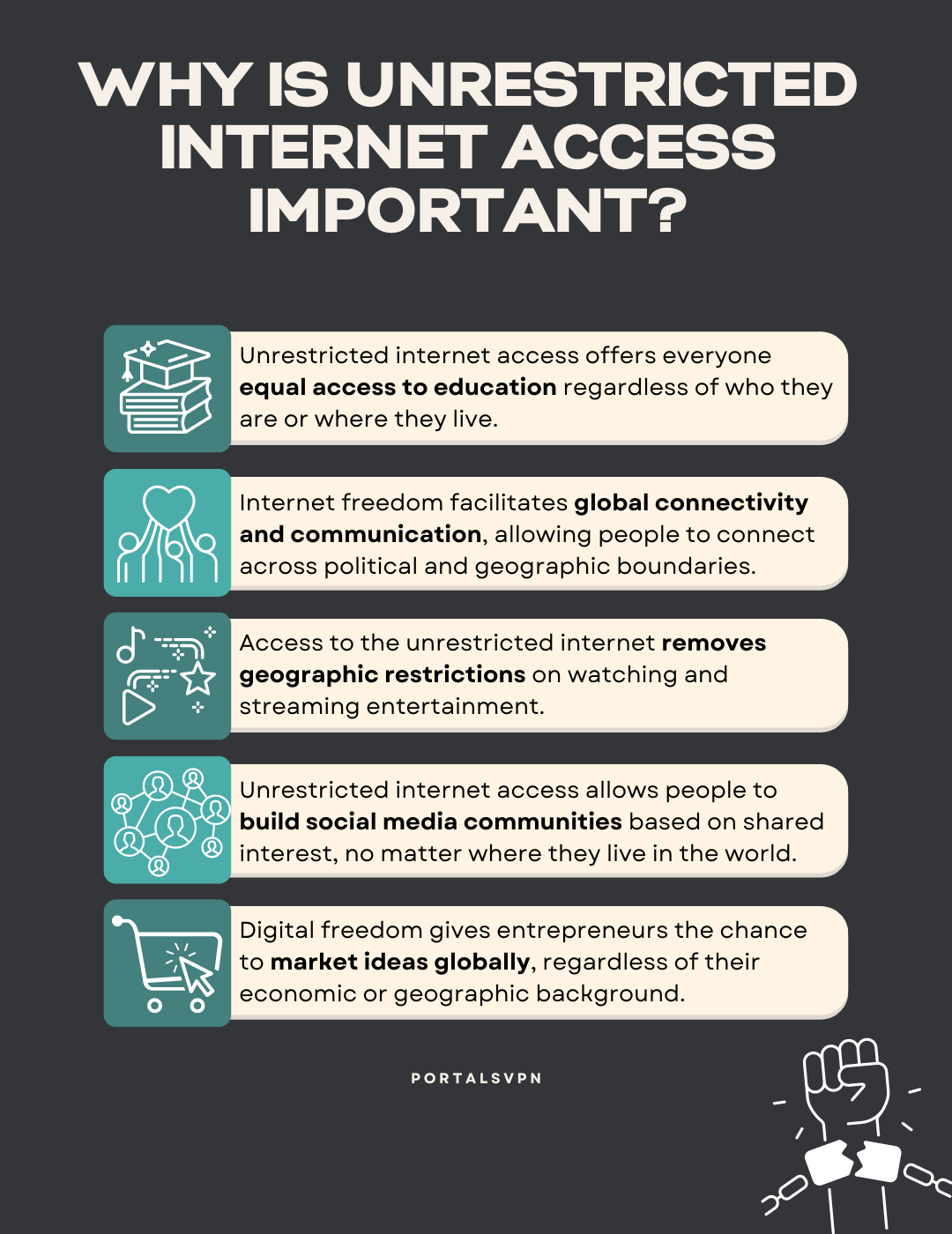
Internet freedom benefits society in various ways. Here are six positives to consider:
- Equal access to information: Unrestricted internet access gives users access to the full spectrum of information on the web regardless of who they are or where they live. This offers everyone equal opportunities to stay informed, learn essential skills, and pursue professional and personal growth through education.
- Global connectivity and communication: The internet has changed communication for the better by making it more efficient, meaning individuals can share ideas and learn from each other across political and geographic boundaries.
- Freedom of expression: Unrestricted internet access promotes freedom of expression, whereby individuals can speak their mind without fear of legal repercussions. This is a fundamental human right. Restricting access to the internet and punishing those who express controversial views inhibits this freedom.
- Entertainment: The unrestricted internet removes traditional geographic barriers to watching and streaming entertainment. In the current landscape, users are only allowed to watch content available in their region. With total internet freedom, individuals can browse content worldwide, providing new opportunities for enjoyment, cultural exploration, and education.
- Social networking: With internet freedom, individuals can use social media to exchange ideas and build digital communities based on shared interests. But for many countries, access to global social media sites like Instagram and Facebook aren’t a given. Citizens in China, for example, cannot access Western social media platforms and can only use sites controlled and monitored by the country, like WeChat.
- E-Commerce: Digital freedom gives entrepreneurs worldwide the chance to market, provide, and sell their goods or services online to a global audience. This provides equal opportunities and means that innovators can find success regardless of their social, economic, or geographic status.
The dangers and risks of unrestricted internet access
It goes without saying that unrestricted internet access is a risk. Let’s take a look at some potential dangers and how to mitigate them.
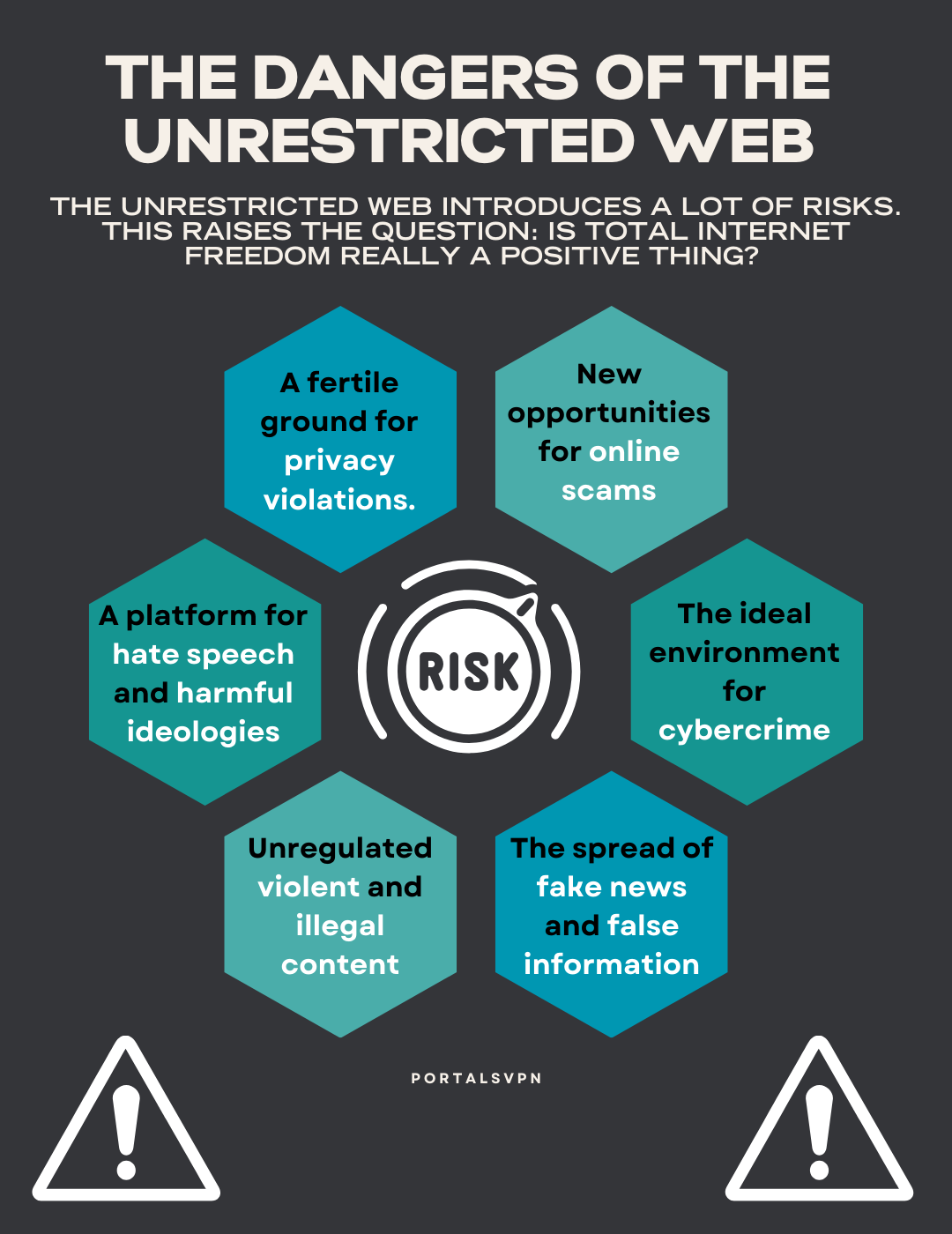
To elaborate, let’s dive deeper and take a look at six prevalent concerns in more detail.
Privacy concerns
Unrestricted internet access may cultivate a fertile ground for privacy violations. For instance, without legislation governing the rules of the web, third-parties could use surveillance tools like cookies to track browsing history without obtaining consent.
Concerningly, ISPs could also utilize more invasive measures, like deep packet inspections (DPI)—a surveillance tactic that inspects data sent over a computer network to collect detailed information about a user’s online activities. They could then use this data for their own purposes, or sell it for profit, all without obtaining consent or fearing repercussion.
Cybersecurity issues and online scams
Without barriers on the internet, cybercriminals have more opportunities to lure unsuspecting victims and steal user data. Theoretically, a censorship-free web means users can access all sites without restriction. If a user cannot separate the legitimate from the harmful, they may fall victim to phishing scams or download malware to their device accidentally. As ever, the solution to this challenge is proper and effective cyber education.
Inappropriate content
This is the issue that springs to mind for most people when they think of an unrestricted, unregulated web. The internet is filled with content that most people would rather not see—exploitative material, violence and gore, hate speech and extremism, drugs and illegal activities.
While adults are more than capable of deciding what content they do and do not engage with online, children may be more susceptible to and profoundly impacted by inappropriate content. That said, adult supervision and proper education can help to mitigate these concerns. You’ll find a more detailed discussion on unrestricted internet access at a young age down below.
Misinformation and fake news
One serious concern with unrestricted internet access is that digital democracy gives everyone a platform that they can use to share their views. This is important for free speech, but it also means every individual can share information online without restriction, even if it is factually incorrect.
This puts the ball in the court of the end user to do their own research and separate fact from fiction. While many can do this due diligence themselves with the help of social media sites and AI tools like ChatGPT, some may fall victim to misinformation. This could aid the spread of fake news and potentially harmful ideologies.
Unrestricted internet access: effects at a young age

The most powerful case for a restricted internet is to safeguard children from accessing harmful content. The lives of young people are intertwined with the digital world in the modern day. And as many as 63% of parents believe this negatively impacts their child, according to a study by internet Matters.
The primary concern with unrestricted internet access as a child is that children lack the experience to know which content they should and shouldn’t engage with. While adults can (in theory) take a ‘common-sense approach’ to navigate the unrestricted internet, children may struggle to separate fact from fiction, and could be more profoundly impacted by inappropriate content, potentially altering their view of the world and how they interact with others.
For instance, when exposed to unrestricted content online that promotes racism, sexism, or violence, a child without the knowledge to put this information in context may take these harmful ideologies as the truth. Additionally, when bombarded with spam links, phishing scams, and malicious sites, young people may struggle to separate what is legitimate from what is untrustworthy. Consider a webpage that promises a free iPhone should a user enter their personal details or home address—you can see why this is a cause for concern.
Of course, adults access inappropriate content either willingly or unwillingly too. And many still fall for malicious scams on a regular basis, but this isn’t the primary concern. The critical issue is that children will be more significantly impacted by the content, both positive and negative, that they find on the web.
‘Positive content’ is important here because there are many benefits for children who use the internet. The opportunity to build social connections online, the chance to improve their knowledge, and the opportunity to build technological skills in a world that is increasingly reliant on technology mean internet use can be an incredibly positive thing for kids.
But this still doesn’t take away from the inherent risks, and parents must always supervise and educate their children to ensure young people can avoid the dangers of the digital world.
Is it legal to have unrestricted internet access?
While it is legal to access most sites on the internet in democratic countries, completely unrestricted internet access isn’t possible anywhere in the world. For instance, accessing geo-restricted content is typically disallowed, and visiting sites that are illegal, such as drug marketplaces and illegal pornography, is always forbidden.
Some less democratic countries have outlawed unrestricted internet access to monitor the population and maintain political stability. Services like virtual private networks (VPNs), proxy servers, and the Tor browser are criminalized in countries like Oman, Iraq, Belarus, and North Korea, for instance. In other countries like China, Egypt, Russia, and the UAE, the government controls which third-party access points the public can use.
So the answer to whether it’s legal to have unrestricted internet access is: It depends on where you live.
How to access unrestricted internet?
The internet is currently restricted in some form or the other for every individual worldwide. However, should someone want to remove constrictions and access the unrestricted internet, there are several different ways to do so with the help of specialized tools. Let’s look at those tools now.
VPNs
A virtual private network (VPN) is a service that lets you securely connect to the internet through an intermediary server. This creates an encrypted tunnel between your device and the web, making your connection private and ensuring it is much harder for entities to track or censor your traffic.
Whenever your computer connects to the internet, it gets an Internet Protocol (IP) address—a unique identifier that links to your device and provides an approximation of your location. When you use a VPN, your IP address will be disguised as that of the VPN service provider, meaning you can hide your true location. For this reason, VPNs are commonly used to bypass restrictions and access geo-restricted content.
Concerns surrounding VPNs
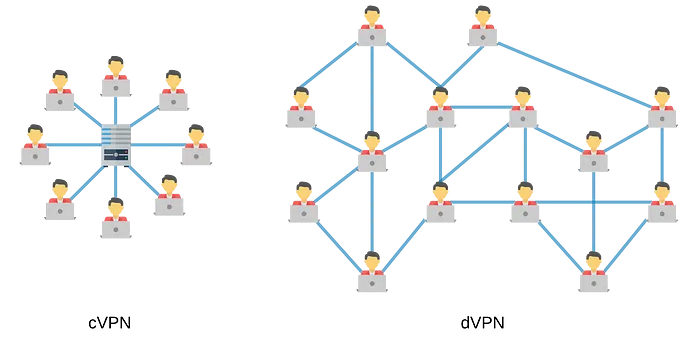
VPNs have come under scrutiny in recent years because of their centralized nature. All traffic passes through the VPN provider’s servers. This poses a couple of problems. First, it means third parties can identify when someone is using a VPN IP and block their connection to certain sites. While there are ways to bypass a VPN block, it’s a game of cat and mouse—the VPN provider updates their IPs and obfuscation methods while the third parties improve their detection methods. Second, the centralized servers mean VPN providers can collect user logs—even if they say they don’t. If they choose, they can then sell this data or provide it to the government upon request.
For these reasons, the decentralized VPN (dVPN) has emerged as a popular alternative in recent years. These VPNs operate on a decentralized network of community-run nodes operated by people around the world. That means user traffic doesn’t pass through centralized servers, making collecting logs in a centralized manner much less likely from a technology standpoint. It also makes it significantly more difficult for entities to track, block, or censor your connection because IPs are mostly residential instead of being easily identifiable as those of the centralized VPN provider.
Tor
The Onion Router (Tor) is a network of thousands of nodes (servers) run by volunteers. When you access a website using the service, Tor encrypts your request and sends it through several random nodes in the network, replacing your true IP address with that of the final node in the sequence. Each node only peels back a single layer of the encrypted path, knowing nothing of the route or final destination of the request. This makes users much harder to trace and censor, as every connection has multiple layers of encryption—hence the name “onion routing”.
Earlier we referred to the internet as an iceberg, wherein 96% of content lives below the surface, inaccessible by regular search engines. Tor browser offers a way to access this content—both legal and illegal—via the dark web. However, it should be said that Tor’s multi-layer encryption process takes a lot of resources, so the service has a reputation for being slow to use. It’s also important to note that using Tor may raise a red flag for illegal activity in certain countries and institutions. Therefore, it’s best to only use this service only if you absolutely require it.
Proxy servers
A proxy server is a server that acts as an intermediary between the end user and the websites they visit online. When you submit a request to a web page, that request travels first through the proxy server. The proxy can alter your data packets during this process before forwarding the web page data to you so you can view it in your browser.
The proxy server is essentially a computer on the internet, meaning it has a separate IP address. That means it can change your IP to that of the proxy so web pages don’t know your location. Incidentally, proxy servers are also often used by employers and parents for censorship because they can block certain IP addresses, preventing access to specific websites.
Proxy servers are a good way to access geo-restricted content, but they don’t provide the same level of privacy that a VPN or dVPN offers.
dVPN vs. VPN vs. Tor vs. Proxy: Which is best?
You might think that the four methods for accessing the unrestricted web listed above share many similarities. And this is true, but they also have some critical differences. Here’s a helpful table to put things into perspective.
| Feature | Proxy | Tor | VPN | dVPN |
|---|---|---|---|---|
| Data privacy | ✓ | ✓ | ✓ | |
| Data encryption | ✓ | ✓ | ✓ | |
| Accessing geo-restricted content | ✓ | ✓ | ✓ | |
| Streaming compatibility | ✓ | ✓ | ✓ | |
| Accessing the dark web | ✓ | |||
| Accessing the open web | ✓ | ✓ | ✓ | ✓ |
| Hides IP Address | ✓ | ✓ | ✓ | ✓ |
| Fast speed | ✓ | ✓ | ✓ | |
| Mobile compatibility | ✓ | ✓ | ✓ | |
| Decentralized (much harder to collect user logs) | ✓ | ✓ | ||
| Ease of use | ✓ | ✓ |
How to stay safe using unrestricted internet access?
The unrestricted internet is filled to the brim with dangers. It’s important to remain aware and implement best practices to limit your risk. Here are some tips.
- Use a reliable dVPN or VPN: Make sure you choose a dVPN or VPN provider with strong encryption standards and a good track record. A free VPN usually means the provider will collect logs. Opt for a dVPN to make sure this is almost impossible.
- Be cautious of scams: The best defense against scams is proper education. Understand how malware is usually packaged and learn what phishing scams entail.
- Use unique passwords: Never use the same password for more than one service. Make sure your passwords are unique and complex. A common suggestion is to use a password manager to store randomly-generated passwords.
- Stay on top of security updates: Always update your software. Bad actors will expose any weaknesses they can—security updates help to patch up these gaps in your line of defense.
The future of unrestricted internet

Censorship on the web is likely to get worse before it gets better. As we mentioned earlier, internet freedom has declined for the 13th year in a row. This is in part due to geopolitical tensions. It is also because Artificial Intelligence (AI) is making it easier to block and restrict access to content.
In February 2024, Time published an article titled ‘The Future of Censorship is AI-Generated’, in which they said: ‘Imagine a world where your word processor prevents you from analyzing, criticizing, lauding, or reporting on a topic deemed “harmful” by an AI programmed to only process ideas that are “respectful and appropriate for all”. This is the crux of the current debate surrounding censorship. If the content we access on the web is determined not by individuals but by AI, we risk creating a homogenous internet where free speech and diverse perspectives are suppressed.
The intersection between internet freedom and digital safety is one that will be constantly debated over the coming years. Unrestricted internet access offers a lot of benefits, but also introduces numerous risks. For those with digital literacy who can navigate the web with confidence, internet freedom will allow them to explore the web as they like. This is a plus for many, but could also provide a fertile ground for cybercriminals, online scams, and illegal content.
And what about those who lack the expertise or knowledge to separate legitimate sites from malicious pages? Of course, it’s important to mention that programs like malware analysis tools can offer a solution to this. And, in the future, Artificial Intelligence will make identifying malicious sites even easier. However, for the time being, there were over 1 million US identity theft reports submitted in 2023 according to the Federal Trade Commission. And let’s remember that this figure represents an internet that is, for the most part, heavily regulated. It’s clear we still have a way to go.
This raises the question: is internet freedom on a global scale a good thing? Or is it for the best that we leave unrestricted internet access to those who know how to obtain it through tools like dVPNs? It’s certainly up for debate.