VPN Ban: What Is It and Where Are VPNs Banned?
VPNs are widely used to protect privacy and bypass restrictions, yet they are increasingly becoming targets themselves. Governments, ISPs, streaming platforms, and institutions are deploying sophisticated methods to detect, block, or criminalize VPN usage. In some regions, using the wrong VPN can lead to fines, surveillance, or far worse consequences. This article explains how VPN bans work, where they are enforced, and what options remain for users navigating an increasingly restricted internet.

Key takeaways
- VPN bans rely on IP blacklisting, deep packet inspection, and nationwide firewalls rather than simple website blocking.
- In several countries, centralized VPN use is illegal or heavily restricted, exposing users to fines, surveillance, or imprisonment.
- Streaming platforms and financial services actively block VPN traffic to enforce licensing and fraud prevention rules.
- Decentralized VPNs and alternative tools are harder to detect, making them more viable in regions with aggressive VPN enforcement.
With over 1.5 billion VPN users globally, many governments and corporations are tightening policies to restrict the usage of these tools. As of 2024, VPN bans are enforced in at least 16 countries worldwide. Five countries have made all centralized VPN usage illegal. The remaining eleven heavily restrict or censor the way people access the internet.
Unrestricted internet access is a modern human right, but internet freedom has declined for the fourteenth consecutive year, according to Freedom House. Part of the problem is a drastic increase in VPN bans across countries like China, Russia, and Oman. Alongside VPN security concerns and the threat of VPN providers selling user logs (even if they say they don’t), there’s an important question to be asked: Are centralized VPNs still the best way to stay safe online? Or should privacy-conscious users begin to look for alternatives?
We’ll explore the outlook and implications of VPN bans in this guide. We’ll also reveal several methods individuals can use to bypass or prevent these bans and access uncensored, open information. First, though, let’s take a closer look at how VPN bans work.
What is a VPN ban?
A VPN ban is a restriction imposed by a third-party, such as a government, network administrator, or destination service (like Netflix or another streaming service), to prevent users from accessing the internet via a Virtual Private Network (VPN). These bans target the underlying protocols, domains, and IP addresses associated with centralized VPN providers to block or limit their functionality.
VPN bans can occur either at the network level where the user is accessing the internet (e.g., by an ISP or school network administrator), or at the destination service level (such as Netflix blocking known VPN IPs). There are three methods that are typically used to enact and enforce these bans:
- VPN IP blocking: Centralized VPN providers use a fixed number of dedicated IP addresses. Once a destination service identifies these IPs, they can blacklist them by adding them to a network blocklist, preventing user access. Some centralized VPNs aim to avoid this by regularly changing their IP addresses, but governments and corporations are never far behind.
- Deep packet inspection (DPI): This is a much more sophisticated method to block VPN usage. It involves inspecting data packet headers and payloads to find hidden VPN traffic within a user’s network. Once an ISP or, in some cases, government body, identifies that traffic by analyzing the user’s data flows, they will then take steps to block or throttle the connection. In many countries that enforce bans, users can also be fined or imprisoned if their connection is discovered.
- Firewalls: Some countries deploy regional firewalls that block access to VPN services at the ISP level. For instance, China’s notorious “Great Firewall” blocks access to many foreign (usually Western) websites, including VPN sites. Instead, the government only allows individuals to access selected domestic sites, controlling the spread of information.
Each of these methods adds a layer of control, making it harder for individuals to use or access VPNs.
Who can ban VPNs and why are they being blocked?
Now that we’ve answered the ‘what’, let’s look at the ‘who’. Which entities want to enforce VPN bans in 2024, and why is that the case?
Governments
Some governments block VPN usage to control the spread of information and maintain political stability. As VPNs disguise a user’s true IP address, individuals can use them to browse blocked websites in other countries. Banning VPNs, to some authorities, is the easiest way to prevent dissent and enforce social norms.
Government VPN bans are typically the most sophisticated and widespread. They often employ DPI and nationwide firewalls to maintain control. Some governments also leverage local Internet Service Providers (ISPs) by obligating these providers to block VPN traffic or report VPN use. If the government finds individuals using VPNs, they can fine or even imprison them.
Corporations
Many corporations block or restrict VPN usage within their networks for productivity reasons. This is often to stop employees from accessing non-work-related content, preventing distractions.
Schools
Schools also implement VPN bans to prevent students from getting distracted. Many educational institutes also ban VPNs to stop children from accessing unauthorized or inappropriate content.
To achieve this, most schools implement internal firewalls or use IP blocking to prevent access to VPN websites. Many will also use port blocking (identifying and banning known VPN ports, such as 1194 for OpenVPN) to block multiple VPNs at once. These measures aren’t as robust as those employed by governments, but for the needs of schools, they’re still effective.
Streaming services
As VPNs let users bypass geographic restrictions and access digital content from different regions, many streaming services enforce VPN bans to adhere to licensing agreements for regional content. Typically, these entities will use IP blacklisting to identify and block known centralized VPN IP addresses.
Financial institutions
Certain financial institutions prevent individuals from accessing their services whilst using a VPN. This is because VPNs mask a user’s location, making it difficult for financial institutions to verify the authenticity of login attempts, which can make it more challenging to detect fraud. Some will block VPN IP ranges outright to prevent access from unknown locations.
In which countries are VPNs banned?
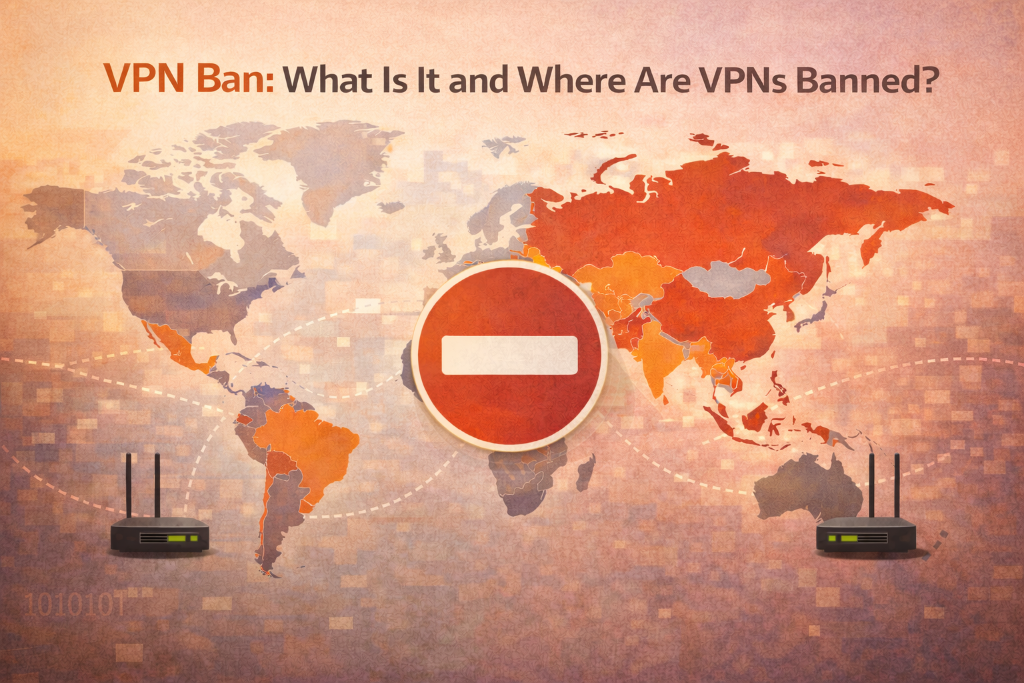
Sixteen countries have restricted VPN use in some way. In most cases, this is to push regional agendas and prevent outside influencers from foreign media. Sadly, VPN blocking is often an extension of the desire to inhibit free speech.
In the table below, we’ve outlined which countries ban or restrict VPN usage. We’ll also explain why these policies exist and the risk users take on when attempting to bypass these restrictions. Let’s answer the question: Where is VPN banned or restricted?
| Country | Status | Risk when bypassing | Reason |
|---|---|---|---|
| Russia | Restricted | Mid risk | Russia’s 2017 law demands that VPNs ban websites that are outlawed by the Russian government. They said this was to prevent piracy, but it is likely to control the spread of foreign media. |
| China | Restricted | High risk | China only allows government-approved VPNs. They do this to control information flow and prevent foreign influence. |
| North Korea | Illegal | Very high risk | As perhaps the world’s most totalitarian country, North Korea bans all VPNs to strictly control citizens’ access to information. |
| Belarus | Illegal | Very high risk | Belarus has outlawed all VPN use to limit access to foreign information and prevent political dissent. |
| Iraq | Illegal | Mid risk | Iraq initially banned VPN usage in 2014 to counter terrorism from ISIS. The ban still exists today. |
| The UAE | Restricted | High risk | The UAE has heavy regulations of VPN usage, primarily to prevent the circumvention of content censorship. |
| Turkmenistan | Illegal | Very high risk | As one of the world’s most authoritarian countries, Turkmenistan maintains full control over internet access, including VPNs. They even make citizens swear by the Quran that they won’t access a VPN. |
| Turkey | Restricted | Mid risk | While VPNs are mostly legal in Turkey, they are heavily restricted to control the spread of political information. |
| India | Restricted | Low risk | Is VPN banned in India? No, but VPN providers are required by law to maintain user logs. This means authorities can request this data, defeating the purpose of a VPN. |
| Venezuela | Restricted | Low risk | Venezuela hasn’t outlawed VPN usage. However, they have a lot of internet restrictions and have made efforts to prevent usage in the past. |
| Saudi Arabia | Restricted | Very high risk | While VPNs aren’t illegal in Saudi Arabia, the government requires that all VPN providers comply with the country’s internet censorship laws. Those that use an unlawful VPN can face imprisonment and fines. |
| Egypt | Restricted | Mid risk | VPNs aren’t banned in Egypt, but anyone attempting to access a blocked website using one could face jail time or heavy fines. |
| Uganda | Restricted | Low risk | Uganda is an outlier. The country blocked VPNs after citizens began to use them to bypass the country’s social media tax. However, while this policy still exists, VPNs aren’t illegal. |
| Iran | Illegal | Very high risk | VPN usage is illegal in Iran except for those with a permit. This is primarily to prevent access to foreign websites. |
| Oman | Restricted | Mid risk | Only government-approved VPNs are legal in Oman. As you can guess, all of these VPNs collect user logs. |
| Pakistan | Restricted | Mid risk | Pakistan only allows authorized VPN providers that collect user logs. They claim to do this to combat cybercrime and illegal activity. |
Other countries don’t ban VPN usage. However, they may still consider it a crime to access certain banned websites with a VPN. In Brazil, for instance, users can be fined for accessing X (formerly Twitter), even when using a VPN solution.
As you can see, VPNs aren’t a foolproof way to bypass internet censorship. The technical efforts to block VPNs by governments, network administrators, corporations, and streaming companies show that VPNs simply can’t always protect you.
Despite the efforts of centralized VPN providers, third parties are managing to stay one step ahead, with VPN blockers becoming more sophisticated each year. Let’s explore some of the legal risks that users attempting to bypass VPN bans face in different countries.
Legal risks for VPN users in countries with VPN bans
Can VPN be blocked by governments? As we’ve discussed, they can, and using VPNs in banned countries comes with various risks, from fines and asset seizures to harsh punishments and imprisonment. These laws also apply to tourists. The section below will discuss some of these risks for high-profile countries that enforce VPN banning.
- China: In China, users can face termination of their internet service, fines, or even imprisonment if they attempt to use non-approved VPNs to bypass The Great Firewall. While millions of Chinese citizens still use VPNs for day-to-day tasks, it’s important to exercise caution or seek an alternative. In 2023, for instance, a Chinese programmer was fined 1m yuan (approximately $139,000) for attempting to connect to international networks through a VPN.
- Russia: As with China, Russian citizens can only access government-approved VPNs, which are forced to collect user logs. It is also illegal to access content censored by the government. Those convicted can face heavy fines and even imprisonment.
- Turkmenistan: As Turkmenistan is one of the most authoritarian countries in the world, they’re incredibly harsh on VPN use. Those convicted of installing VPNs can face up to 15 days in prison and a fine of over $8,600.
- The UAE: Breaching the UAE’s strict VPN laws can be incredibly expensive. Users face fines up to 2 million dirhams (approximately $544,000) if they access restricted content. As surveillance is also robust, using a centralized VPN in the UAE is generally a bad idea.
- Iran: The Iranian Parliament is tight-lipped about how they intend to enforce VPN bans. However, the government can pursue fines and criminal charges for unauthorized use if they please. It’s little surprise Iran was ranked the worst country for internet rights in 2023, according to Freedom House.
- Saudi Arabia: The Saudi Communications and Information Technology Commission (CITC) issues fines for unlawful VPN usage of up to 500,000 SAR (approximately $133,000) and up to one year jail time, as per Together for Justice.
- North Korea: VPNs are outlawed in North Korea, and most citizens have no access to the internet. Those that attempt to use a VPN could face serious punishments, such as jail time. The risks in North Korea are the highest globally, both for citizens and tourists.
- Egypt: While VPNs aren’t illegal in Egypt, users can still be fined between 50,000 to 100,000 EGP (approximately $1000 - $2000) for using one to access restricted websites. Those prosecuted may also face at least one year imprisonment.
- Iraq: Citizens in Iraq can face heavy fines and imprisonment if they are caught using a VPN in Iraq. However, the country’s infrastructure isn’t as well-developed as that of China, North Korea, or Russia, meaning authorities have a harder time enforcing these laws.
- Oman: While using a VPN isn’t illegal in Oman, users can be punished for accessing content that doesn’t align with the government’s standards. For instance, using a VPN to access explicit content could result in a $1300 fine.
Impact of VPN bans
For individuals, VPN bans from services can be a significant inconvenience. If people can’t access certain websites and services (such as streaming services) while using a VPN, this means they need to choose between protecting their privacy and accessing the full breadth of information available on the web. With these bans in place, there is nothing to protect citizens from security risks, privacy violations, and snooping from third parties.
However, there’s a broader societal issue to consider. VPN bans are more than a danger to online anonymity. They inhibit free speech and prevent users from accessing information. This means individuals have no opportunities to broaden their mind and benefit from differing perspectives. It also allows authoritarian governments to maintain political and social control over the population, as is the case in North Korea.
Consider this: all of the countries that ban or restrict VPNs are classified as having little to no internet freedom on Freedom House’s Freedom on the Net Report. Why? Because these countries are intent on preventing dissent and maintaining political stability at all costs.
VPN bans aren’t the sole reason that individuals, businesses, and societies have little to no internet freedom, but they are a symptom of a wider problem. Using a VPN gives individuals the power to learn from opposing viewpoints and access content from other countries. VPN blockers are simply a way for authoritarian governments to ensure this doesn’t happen.
In the future, artificial intelligence will play an increasingly important role in this battle. Governments are already experimenting with AI technology for surveillance, and it isn’t a reach to predict that the capabilities of machine learning will soon be used to root out VPN usage in restrictive countries. These services can analyze traffic patterns to determine whether IPs come from VPNs or proxies more reliably than humans. While these AI VPN detection services are primarily used for threat prevention as of now, this could change in the future.
Alternatives to VPNs in regions with bans
It’s clear that, in many cases, using a VPN in a region with a ban isn’t a risk worth taking. Fortunately, there are alternatives that make it much harder for third parties to track, block or censor you. Let’s explore some of those VPN alternatives now.
Decentralized VPNs
A dVPN (decentralized VPN) is a VPN that works on a decentralized architecture of community-driven nodes. Each node is hosted by an individual or business. These nodes act as small, temporary servers that form a larger peer-to-peer network.
As dVPNs run on a decentralized architecture, they are much harder to trace. While some countries may still seek out decentralized VPN users with techniques like deep packet inspection, the dVPN has two key advantages that make it much harder to detect and block. Let’s take a look.
- No centralized servers: When you connect to a dVPN provider, your traffic is routed through a randomly selected residential node instead of passing through centralized VPN servers. This makes it significantly harder to detect that your IP belongs to a VPN, as dVPNs don’t rely on a fixed set of IP addresses like traditional VPNs do. As a result, it becomes more difficult for governments or other entities to recognize, track, or block your connection.
- Minimal risk of data logging: In countries like China, Russia, and India, government-approved VPNs often collect user logs, which can then be shared with authorities. With a dVPN, traffic is distributed across a decentralized network rather than passing through a centralized server, reducing the potential for data tracking. Since there is no single entity managing all connections, the ability to collect and store logs is significantly minimized, offering a higher degree of privacy.
These advantages could make dVPNs a preferable choice for those who are looking to avoid penalties in countries with centralized VPN bans. They’re also the most effective way to bypass geographic restrictions on media and avoid connection throttling.
The Onion Router (Tor)
Tor is a free software that encrypts traffic by routing it through multiple volunteer-run nodes in a network. As each node only knows the last and next node in the chain, it’s much harder to detect the flow of traffic from the origin to the endpoint.
However, many nations like China, Russia, Belarus, Turkmenistan and Iran, have also made accessing the Tor browser illegal. In addition, Tor makes it almost impossible for entities to see your browsing activity, but governments and ISPs can easily detect that you’re using the solution.
Many of these countries will also simply block access to the entry nodes—the initial servers you use to connect to the network. It’s therefore necessary to use Tor bridges to gain access, which can be a challenge for those who lack technical expertise.
Proxy servers
Proxy servers are another popular VPN alternative that act as an intermediary between your device and the internet. In the process, they mask your IP.
However, many of the countries who crack down on VPNs have also made proxies illegal. China, Russia, Iran, North Korea, Saudi Arabia and Turkmenistan, for instance, all actively seek to track and block proxy use. And, as proxies are usually easier to detect than VPNs, these aren’t a viable alternative for accessing blocked websites in restrictive countries.
On which platforms are VPNs blocked?
Aside from the growing list of countries where VPNs are banned, several platforms and services also block VPN usage to prevent users from bypassing geographic restrictions.
- Netflix: Streaming giant Netflix has been cracking down on VPN use for many years in an attempt to prevent users accessing region-locked content.
- Hulu: As Hulu is a US-exclusive service, it has also gone to extreme lengths to prevent non-US customers from accessing the platform with VPNs.
- Amazon Prime Video: As with other streaming services, Amazon Prime cracks down on VPN use to prevent users from bypassing geographic restrictions.
- BBC iPlayer: The BBC monitors the number of simultaneous connections coming from a single IP address to identify VPNs. They then use this to block access.
- Threads: At one stage, Meta began to block users trying to access Threads from inside the European Union. However, this ban has since been lifted.
- Gaming platforms: Many gaming platforms like Steam and Playstation Network have region-specific content. As such, they block VPNs. Offenders may have their accounts locked.
- Banking platforms: Banks have perhaps the most well-founded reason for blocking VPN usage. They do this to prevent fraud and comply with legal regulations.
Signs of a VPN being blocked
When a VPN is blocked, there are a few telltale signs that will give the game away. When it comes to destination service VPN bans (such as a Netflix VPN ban), here are some to look out for:
- Error messages on websites: If a service provider detects that you’re using a VPN, they may tell you outright with an error message. This is especially common on streaming services.
- Account suspensions or warnings: Certain platforms will suspend your account temporarily or permanently if they detect VPN use.
Next, if a government or ISP detects you’re using a VPN in a country where the VPN is banned, here’s what you can expect if the VPN is blocked:
- VPN website inaccessible: In many cases with country-wide VPN bans, the government will simply block access to the VPN provider website at its source, making it impossible to download the VPN apps.
- Failure to connect: If you can’t connect to a VPN, this may be the result of IP blocking or firewall restrictions that stop the traffic from reaching the VPN server or node.
- Extremely slow performance: If you’re noticing that your VPN is running incredibly slowly, this often indicates network interference as a result of the VPN block.
How to bypass a VPN ban?
The easiest and least risky way to bypass a VPN ban, especially in countries where using a VPN is a crime, is to use an alternative. Other options like dVPNs are much harder to detect and block, making them a better choice for anonymity and security.
However, there are several techniques you can use to bypass VPN bans when required.
Switching servers
One approach is to switch servers or try a different VPN provider. A third party may have identified and blocked an IP associated with a specific VPN solution, but this doesn’t mean they’ve accounted for every IP address from every provider.
Using obfuscated servers
Some VPN providers offer obfuscated servers. These hide identifiable VPN traffic as regular HTTPS traffic, making it more challenging to detect. However, know that motivated ISPs can often still see that you’re using an obfuscated VPN, so if the ISP is working in collaboration with the government, this is still a risk.
Getting a dedicated VPN IP address
Another option is to get a dedicated IP address for another region. As you’ll be the only person using this IP, you’ll be harder to detect. However, note that this only works for IP-based blocks. It won’t help with deep packet inspection, as this relies on data patterns and encryption methods.
How to prevent a VPN getting banned?
There is no fully undetectable VPN, but if your chosen VPN hasn’t yet been banned or blocked, there are several steps you can take to prevent this from occurring for as long as possible. Here are some tips.
- Use obfuscated servers: As with bypassing VPN bans, server obfuscation is also a viable way to avoid detection when using an unbanned VPN.
- Switch up your connection: Change your VPN IP as much as possible by switching your geographic location. This makes you harder to trace. dVPNs connect to a random IP on each connection, making it harder to tell that you’re using a VPN.
- Limit usage: Limit how much you log in and use split tunneling to limit VPN usage to specific tasks. This makes it harder for entities to detect your usage.
Navigating VPN bans can be challenging, but with the right approach and a careful consideration of all options available, you can put yourself in a position to avoid detection and bypass restrictions with care.